Ransom.Win64.MOUNTLOCKER.G

Trojan-Ransom.Win32.MountLocker.g (KASPERSKY)
Windows




Threat Type: Ransomware
Destructiveness: No
Encrypted: Yes
In the wild: Yes
OVERVIEW
This Ransomware arrives on a system as a file dropped by other malware or as a file downloaded unknowingly by users when visiting malicious sites.
It drops files as ransom note. It avoids encrypting files with the following file extensions.
TECHNICAL DETAILS
Arrival Details
This Ransomware arrives on a system as a file dropped by other malware or as a file downloaded unknowingly by users when visiting malicious sites.
Installation
This Ransomware drops the following files:
- {Malware file path and name}.txt (Contains logs and system information)
- %User Temp%\{Random numbers}.bat (Used to delete itself)
(Note: %User Temp% is the current user's Temp folder, which is usually C:\Documents and Settings\{user name}\Local Settings\Temp on Windows 2000(32-bit), XP, and Server 2003(32-bit), or C:\Users\{user name}\AppData\Local\Temp on Windows Vista, 7, 8, 8.1, 2008(64-bit), 2012(64-bit) and 10(64-bit).)
It drops the following copies of itself into the affected system:
- \C$\ProgramData\{Malware file name}.exe
Other System Modifications
This Ransomware adds the following registry entries:
HKEY_CURRENT_USER\Software\Classes\
{Ransomware extension}\shell\Open\
command
(Default) = explorer.exe {Ransom note}
Process Termination
This Ransomware terminates the following services if found on the affected system:
- SQL
- database
- msexchange
It terminates the following processes if found running in the affected system's memory:
- msftesql.exe
- sqlagent.exe
- sqlbrowser.exe
- sqlwriter.exe
- oracle.exe
- ocssd.exe
- dbsnmp.exe
- synctime.exe
- agntsvc.exe
- isqlplussvc.exe
- xfssvccon.exe
- sqlservr.exe
- mydesktopservice.exe
- ocautoupds.exe
- encsvc.exe
- firefoxconfig.exe
- tbirdconfig.exe
- mydesktopqos.exe
- ocomm.exe
- mysqld.exe
- mysqld-nt.exe
- mysqld-opt.exe
- dbeng50.exe
- sqbcoreservice.exe
- excel.exe
- infopath.exe
- msaccess.exe
- mspub.exe
- onenote.exe
- outlook.exe
- powerpnt.exe
- thebat.exe
- steam.exe
- thebat64.exe
- thunderbird.exe
- visio.exe
- winword.exe
- wordpad.exe
- QBW32.exe
- QBW64.exe
- ipython.exe
- wpython.exe
- python.exe
- dumpcap.exe
- procmon.exe
- procmon64.exe
- procexp.exe
- procexp64.exe
Information Theft
This Ransomware gathers the following data:
- Core count
- Total memory size
- Operating system information (e.g. version, architecture)
- Computer name
- User name
- Flag to indicate if executed as administrator
- Domain and group into which the machine is included
Other Details
This Ransomware does the following:
- It propagates to the following file paths if found for higher privilege execution:
- \ADMIN$
- \IPC$
- It installs the following services in its propagation routine:
- Update{Random characters}
It accepts the following parameters:
- /LOGIN= - Specify network username for propagation
- /PASSWORD= - Specify network password for propagation
- /CONSOLE - Log activities through console
- /NODEL - Disable self-deletion
- /NOKILL - Disable service and process killing
- /NOLOG - Disable file logging
- /SHAREALL - Encrypt all shared resources
- /NETWORK - Specify network type
- /PARAMS - Specify command line parameters for launching on other machines
- /TARGET= - Specify path to a file or a directory to be encrypted specifically
- /FAST - Specify buffer size for fast encryption
- /MIN= - Specify minimum file size to encrypt
- /MAX= - Specify maximum file size to encrypt
- /FULLPD - Enable encryption in Program Files, Program Files (x86), ProgramData, and SQL
- /MARKER= - Specify marker file name to drop in each encrypted drive
- /NOLOCK= - Specify paths to avoid in encryption
Ransomware Routine
This Ransomware avoids encrypting files with the following strings in their file path:
- bootmgr
- README_TO_DECRYPT.html
- :\Windows\
- :\System Volume Information\
- :\$RECYCLE.BIN\
- :\SYSTEM.SAV
- :\WINNT
- :\$WINDOWS.~BT\
- :\Windows.old\
- :\PerfLog\
- :\Boot
- :\ProgramData\Microsoft\
- :\ProgramData\Packages\
- $\Windows\
- $\System Volume Information\
- $\$RECYCLE.BIN\
- $\SYSTEM.SAV
- $\WINNT
- $\$WINDOWS.~BT\
- $\Windows.old\
- $\PerfLog\
- $\Boot
- $\ProgramData\Microsoft\
- $\ProgramData\Packages\
- \WindowsApps\
- \Microsoft\Windows\
- \Local\Packages\
- \Windows Defender
- \microsoft shared\
- \Google\Chrome\
- \Mozilla Firefox\
- \Mozilla\Firefox\
- \Internet Explorer\
- \MicrosoftEdge\
- \Tor Browser\
- \AppData\Local\Temp\
- Program Files
- Program Files (x86)
- ProgramData
- SQL
It appends the following extension to the file name of the encrypted files:
- .quantum
It drops the following file(s) as ransom note:
- {Encrypted directory}\README_TO_DECRYPT.html
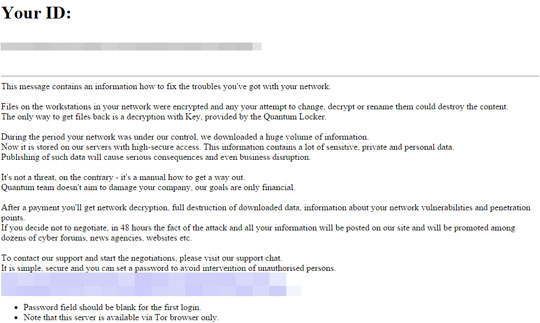
It avoids encrypting files with the following file extensions:
- exe
- dll
- sys
- msi
- mui
- inf
- cat
- bat
- cmd
- ps1
- vbs
- ttf
- fon
- lnk
SOLUTION
Step 1
Before doing any scans, Windows 7, Windows 8, Windows 8.1, and Windows 10 users must disable System Restore to allow full scanning of their computers.
Step 2
Note that not all files, folders, and registry keys and entries are installed on your computer during this malware's/spyware's/grayware's execution. This may be due to incomplete installation or other operating system conditions. If you do not find the same files/folders/registry information, please proceed to the next step.
Step 3
Restart in Safe Mode
Step 4
Disable this malware service
- Update{Random characters}
Step 5
Delete this registry value
Important: Editing the Windows Registry incorrectly can lead to irreversible system malfunction. Please do this step only if you know how or you can ask assistance from your system administrator. Else, check this Microsoft article first before modifying your computer's registry.
Step 6
Search and delete these files
- \C$\ProgramData\{Malware file name}.exe
- {Malware file path and name}.txt
- %User Temp%\{Random numbers}.bat
- {Encrypted directory}\README_TO_DECRYPT.html
Step 7
Restart in normal mode and scan your computer with your Trend Micro product for files detected as Ransom.Win64.MOUNTLOCKER.G. If the detected files have already been cleaned, deleted, or quarantined by your Trend Micro product, no further step is required. You may opt to simply delete the quarantined files. Please check this Knowledge Base page for more information.
Step 8
Restore encrypted files from backup.
Did this description help? Tell us how we did.