Ransom.Win32.TERMITE.THLAOBD

Trojan-Ransom.Babyk(IKARUS)
Windows




Threat Type: Ransomware
Destructiveness: No
Encrypted: No
In the wild: Yes
OVERVIEW
This Ransomware arrives on a system as a file dropped by other malware or as a file downloaded unknowingly by users when visiting malicious sites.
It gathers certain information on the affected computer.
It drops files as ransom note. It avoids encrypting files with the following file extensions.
TECHNICAL DETAILS
Arrival Details
This Ransomware arrives on a system as a file dropped by other malware or as a file downloaded unknowingly by users when visiting malicious sites.
Installation
This Ransomware adds the following processes:
- "%System32%\cmd.exe" /c vssadmin.exe delete shadows /all /quiet
It adds the following mutexes to ensure that only one of its copies runs at any one time:
- DoYouWantToHaveSexWithCuongDong
Other System Modifications
This Ransomware modifies the following registry entries:
HKEY_CURRENT_USER\Software\Microsoft\
Windows\CurrentVersion\Explorer\
CLSID\{User CLID}\DefaultIcon
{Default} = %System32%\imageres.dll,-55
Process Termination
This Ransomware terminates the following services if found on the affected system:
- HvHost
- vm3dservice
- vmcompute
- vmicguestinterface
- vmicheartbeat
- vmickvpexchange
- vmicrdv
- vmicshutdown
- vmictimesync
- vmicvmsession
- vmicvss
- vmms
- vss
- sql
- svc$
- memtas
- mepocs
- sophos
- veeam
- backup
- GxVss
- GxBlr
- GxFWD
- GxCVD
- GxCIMgr
- DefWatch
- ccEvtMgr
- ccSetMgr
- SavRoam
- RTVscan
- QBFCService
- QBIDPService
- Intuit.QuickBooks.FCS
- QBCFMonitorService
- YooBackup
- YooIT
- zhudongfangyu
- sophos
- stc_raw_agent
- VSNAPVSS
- VeeamTransportSvc
- VeeamDeploymentService
- VeeamNFSSvc
- veeam
- PDVFSService
- BackupExecVSSProvider
- BackupExecAgentAccelerator
- BackupExecAgentBrowser
- BackupExecDiveciMediaService
- BackupExecJobEngine
- BackupExecManagementService
- BackupExecRPCService
- AcrSch2Svc
- AcronisAgent
- CASAD2DWebSvc
- CAARCUpdateSvc
It terminates the following processes if found running in the affected system's memory:
- vmmem.exe
- vmwp.exe
- sqlservr.exe
- sql.exe
- oracle.exe
- ocssd.exe
- dbsnmp.exe
- synctime.exe
- agntsvc.exe
- isqlplussvc.exe
- xfssvccon.exe
- mydesktopservice.exe
- ocautoupds.exe
- encsvc.exe
- firefox.exe
- tbirdconfig.exe
- mydesktopqos.exe
- ocomm.exe
- dbeng50.exe
- sqbcoreservice.exe
- excel.exe
- infopath.exe
- msaccess.exe
- mspub.exe
- onenote.exe
- outlook.exe
- powerpnt.exe
- steam.exe
- thebat.exe
- thunderbird.exe
- visio.exe
- winword.exe
- wordpad.exe
- Notepad.exe
Information Theft
This Ransomware gathers the following information on the affected computer:
- Number of Processors
- Network Shares
Other Details
This Ransomware does the following:
- By default, it encrypts files in the local drive.
- It changes its encryption method based on the file size.
- Before encryption, it terminates processes and services.
It accepts the following parameters:
- debug - Enables debug logging
- onefile – Process a single specific file
- shares – Encrypt specific network shares
- paths – Encrypt specific path or drive
- sf – control network share enumeration timing
Ransomware Routine
This Ransomware avoids encrypting files with the following strings in their file name:
- autorun.inf
- boot.ini
- bootfont.bin
- bootsect.bak
- bootmgr
- bootmgr.efi
- bootmgfw.efi
- desktop.ini
- iconcache.db
- ntldr
- ntuser.dat
- ntuser.dat.log
- ntuser.ini
- thumbs.db
- How To Restore Your Files.txt
It avoids encrypting files found in the following folders:
- AppData
- Boot
- Windows
- Windows.old
- Tor Browser
- Internet Explorer
- Opera
- Opera Software
- Mozilla
- Mozilla Firefox
- $Recycle.Bin
- ProgramData
- All Users
- Program Files
- Program Files (x86)
It appends the following extension to the file name of the encrypted files:
- .termite
It drops the following file(s) as ransom note:
- How To Restore Your Files.txt:
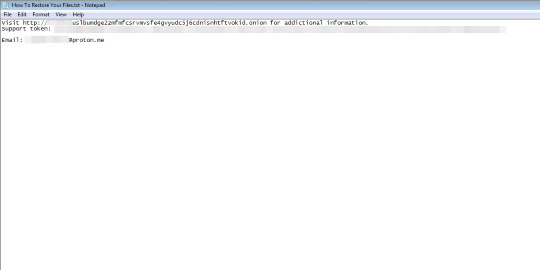
It avoids encrypting files with the following file extensions:
- .termite
SOLUTION
Step 1
Trend Micro Predictive Machine Learning detects and blocks malware at the first sign of its existence, before it executes on your system. When enabled, your Trend Micro product detects this malware under the following machine learning name:
- Troj.Win32.TRX.XXPE50FFF088
Step 2
Before doing any scans, Windows 7, Windows 8, Windows 8.1, and Windows 10 users must disable System Restore to allow full scanning of their computers.
Step 3
Note that not all files, folders, and registry keys and entries are installed on your computer during this malware's/spyware's/grayware's execution. This may be due to incomplete installation or other operating system conditions. If you do not find the same files/folders/registry information, please proceed to the next step.
Step 4
Restore these modified registry values
Important:Editing the Windows Registry incorrectly can lead to irreversible system malfunction. Please do this only if you know how to or you can seek your system administrator's help. You may also check out this Microsoft article first before modifying your computer's registry.
- HKEY_CURRENT_USER\Software\Microsoft\Windows\CurrentVersion\Explorer\CLSID\{User CLID}\DefaultIcon
- {Default} = %System32%\imageres.dll,-55;
- {Default} = %System32%\imageres.dll,-54;
Step 5
Search and delete these files
- How To Restore Your Files.txt;
Step 6
Scan your computer with your Trend Micro product to clean files detected as Ransom.Win32.TERMITE.THLAOBD. If the detected files have already been cleaned, deleted, or quarantined by your Trend Micro product, no further step is required. You may opt to simply delete the quarantined files. Please check the following Trend Micro Support pages for more information:
Step 7
Scan your computer with your Trend Micro product to delete files detected as Ransom.Win32.TERMITE.THLAOBD. If the detected files have already been cleaned, deleted, or quarantined by your Trend Micro product, no further step is required. You may opt to simply delete the quarantined files. Please check the following Trend Micro Support pages for more information:
Step 8
Restore encrypted files from backup.
Did this description help? Tell us how we did.