Ransom.Win32.MAZE.YAAH-A

DeepScan:Generic.Ransom.Maze.89BD156F (BITDEFENDER)
Windows




Threat Type: Ransomware
Destructiveness: No
Encrypted: Yes
In the wild: Yes
OVERVIEW
This Ransomware arrives on a system as a file dropped by other malware or as a file downloaded unknowingly by users when visiting malicious sites.
It drops files as ransom note. It avoids encrypting files with the following file extensions.
TECHNICAL DETAILS
Arrival Details
This Ransomware arrives on a system as a file dropped by other malware or as a file downloaded unknowingly by users when visiting malicious sites.
Installation
This Ransomware drops the following files:
- %ProgramData%\dump001.tmp
- %User Temp%\111.bmp
(Note: %ProgramData% is a version of the Program Files folder where any user on a multi-user computer can make changes to programs. This contains application data for all users. This is usually C:\ProgramData on Windows Vista, 7, 8, 8.1, 2008(64-bit), 2012(64-bit) and 10(64-bit), or C:\Documents and Settings\All Users on Windows Server 2003(32-bit), 2000(32-bit) and XP.. %User Temp% is the current user's Temp folder, which is usually C:\Documents and Settings\{user name}\Local Settings\Temp on Windows 2000(32-bit), XP, and Server 2003(32-bit), or C:\Users\{user name}\AppData\Local\Temp on Windows Vista, 7, 8, 8.1, 2008(64-bit), 2012(64-bit) and 10(64-bit).)
It adds the following processes:
- "C:\{Random characters}\{Random characters}\{Random characters}\..\..\..\Windows\{Random characters}\{Random characters}\..\..\system32\{Random characters}\{Random characters}\{Random characters}\..\..\..\wbem\{Random characters}\{Random characters}\..\..\wmic.exe" shadowcopy delete
Other System Modifications
This Ransomware changes the desktop wallpaper by modifying the following registry entries:
HKEY_CURRENT_USER\Control Panel\Desktop
Wallpaper = %User Temp%\111.bmp
Process Termination
This Ransomware terminates the following processes if found running in the affected system's memory:
- dumpcap.exe
- excel.exe
- fiddler.exe
- msaccess.exe
- mysqld-nt.exe
- outlook.exe
- pipanel.exe
- procexp64.exe
- procexp.exe
- procmon64.exe
- procmon.exe
- python.exe
- taskkill.exe
- visio.exe
- winword.exe -
- x32dbg.exe
- x64dbg.exe
Other Details
This Ransomware displays the following images:
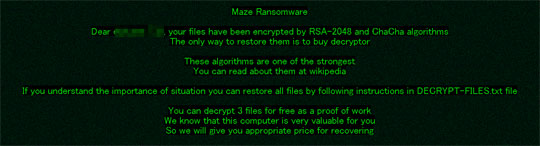
It does the following:
- It uses Windows Text-to-Speech functionality to play the following message:
- {Username}! Alert! {Username}! Alert! Dear {Username}, your files have been encrypted by Maze Ransomware! Attention! You need to buy decryptor in order to restore the files.
Ransomware Routine
This Ransomware avoids encrypting files with the following strings in their file name:
- DECRYPT-FILES.txt
- autorun.inf
- boot.ini
- desktop.ini
- ntuser.dat
- iconcache.db
- bootsect.bak
- ntuser.dat.log
- thumbs.db
- Bootfont.bin
It avoids encrypting files with the following strings in their file path:
- :\Windows
- \Games\
- \Tor Browser\
- \ProgramData\
- \cache2\entries\
- \Low\Content.IE5\
- \User Data\Default\Cache\
- \All Users
- \IETldCache\
- \Local Settings\
- \AppData\Local
- \Program Files
It appends the following extension to the file name of the encrypted files:
- .{Random characters}
It drops the following file(s) as ransom note:
- {Encrypted directory}\DECRYPT-FILES.txt
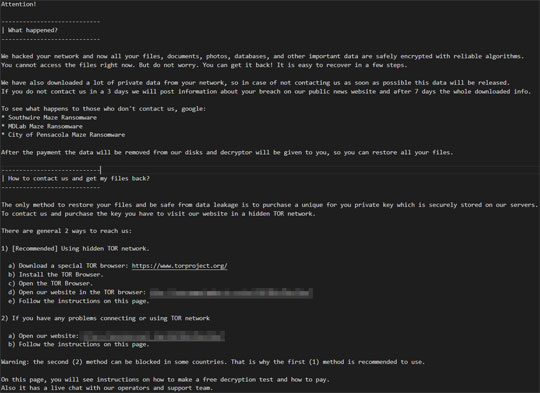
It avoids encrypting files with the following file extensions:
- .lnk
- .exe
- .sys
- .dll
SOLUTION
Step 1
Trend Micro Predictive Machine Learning detects and blocks malware at the first sign of its existence, before it executes on your system. When enabled, your Trend Micro product detects this malware under the following machine learning name:
- Troj.Win32.TRX.XXPE50FFF036P0005
Step 2
Before doing any scans, Windows 7, Windows 8, Windows 8.1, and Windows 10 users must disable System Restore to allow full scanning of their computers.
Step 3
Note that not all files, folders, and registry keys and entries are installed on your computer during this malware's/spyware's/grayware's execution. This may be due to incomplete installation or other operating system conditions. If you do not find the same files/folders/registry information, please proceed to the next step.
Step 4
Restart in Safe Mode
Step 5
Search and delete these files
- %ProgramData%\dump001.tmp
- %User Temp%\111.bmp
- {Encrypted directory}\DECRYPT-FILES.txt
Step 6
Reset your Desktop properties
Step 7
Restart in normal mode and scan your computer with your Trend Micro product for files detected as Ransom.Win32.MAZE.YAAH-A. If the detected files have already been cleaned, deleted, or quarantined by your Trend Micro product, no further step is required. You may opt to simply delete the quarantined files. Please check this Knowledge Base page for more information.
Step 8
Restore encrypted files from backup.
Did this description help? Tell us how we did.