HackTool.Win64.NirSoftPT.SM

HackTool:Win32/Passview (MICROSOFT); PUA.PSWTool.Credentialsfileview (IKARUS)
Windows




Threat Type: Hacking Tool
Destructiveness: No
Encrypted: No
In the wild: Yes
OVERVIEW
This Hacking Tool arrives on a system as a file dropped by other malware or as a file downloaded unknowingly by users when visiting malicious sites.
TECHNICAL DETAILS
Arrival Details
This Hacking Tool arrives on a system as a file dropped by other malware or as a file downloaded unknowingly by users when visiting malicious sites.
Installation
This Hacking Tool drops the following files:
- {Malware Path}\{Malware Name}.cfg - configuration file
Other Details
This Hacking Tool does the following:
- It is used to decrypt passwords and data stored in the following Windows credentials folder:
- %Application Data%\Microsoft\Credentials\
- %AppDataLocal%\Microsoft\Credentials\
- %System%\config\systemprofile\AppData\Local\Microsoft\Credentials\
- It can also be used to decrypt passwords and data stored on external hard drive.
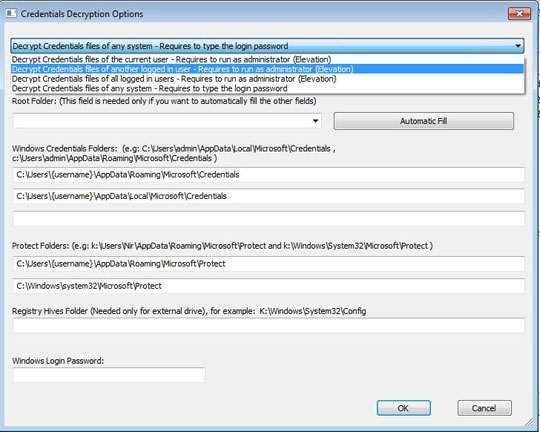
- It displays the following upon execution to allow the user to choose credential decryption options:
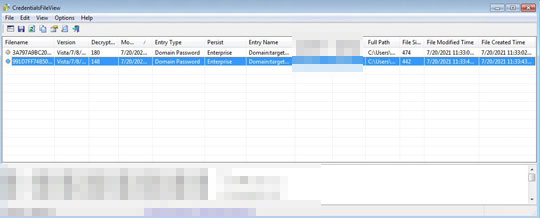
- It displays the following data:
- Filename
- Windows Version
- Decrypted Data Size
- Modified Time
- Entry Type
- Persist
- Entry Name
- Username
- Decrypted Password
- Full Path
- File Size
- File Modified Time
- File Created Time
- It can be ran as it is, or with the following arguments:
- /StartDecrypt - start the program with default configuration
- /deleteregkey
- /nosaveload - start the program and set the configuration
- /savelangfile - export the language file as {filename}_lng.ini
SOLUTION
Step 1
Before doing any scans, Windows 7, Windows 8, Windows 8.1, and Windows 10 users must disable System Restore to allow full scanning of their computers.
Step 2
Note that not all files, folders, and registry keys and entries are installed on your computer during this malware's/spyware's/grayware's execution. This may be due to incomplete installation or other operating system conditions. If you do not find the same files/folders/registry information, please proceed to the next step.
Step 3
Search and delete these files
- {Malware Path}\{Malware Name}.cfg
Step 4
Scan your computer with your Trend Micro product to delete files detected as HackTool.Win64.NirSoftPT.SM. If the detected files have already been cleaned, deleted, or quarantined by your Trend Micro product, no further step is required. You may opt to simply delete the quarantined files. Please check the following Trend Micro Support pages for more information:
Did this description help? Tell us how we did.