Boot.Win32.KILLMBR.AB

Trojan.Win32.KillMBR (IKARUS); Trojan.Win32.DiskWriter.ebe (KASPERSKY)
Windows




Threat Type: Boot malware
Destructiveness: No
Encrypted: No
In the wild: Yes
OVERVIEW
This Boot malware arrives on a system as a file dropped by other malware or as a file downloaded unknowingly by users when visiting malicious sites.
TECHNICAL DETAILS
Arrival Details
This Boot malware arrives on a system as a file dropped by other malware or as a file downloaded unknowingly by users when visiting malicious sites.
Installation
This Boot malware adds the following processes:
- schtasks.exe /Create /TN wininit /ru SYSTEM /SC ONSTART /TR "{Malware Path}\{Malware Filename}.exe"
Autostart Technique
This Boot malware adds the following registry entries to enable its automatic execution at every system startup:
HKEY_CURRENT_USER\Software\Microsoft\
Windows\CurrentVersion\Run
wininit = {Malware Path}\{Malware Filename}.exe
Process Termination
This Boot malware terminates the following processes if found running in the affected system's memory:
- csrss.exe
- wininit.exe
- services.exe
Other Details
This Boot malware does the following:
- It deletes the following registry entry:
- HKEY_CURRENT_USER\Software\Microsoft\Windows\CurrentVersion\Run
winnit
- HKEY_CURRENT_USER\Software\Microsoft\Windows\CurrentVersion\Run
- It does not encrypt files
- Writes into \.\PhysicalDrive0 which causes blue screen:
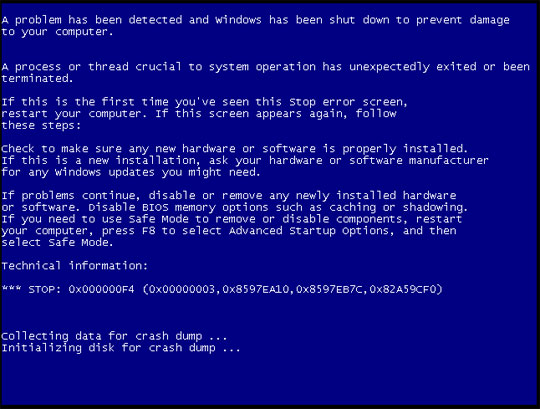
- It edits the affected system's Master Boot Record (MBR) to add its own boot code
- After rebooting the system, it then displays the following as its ransom note:
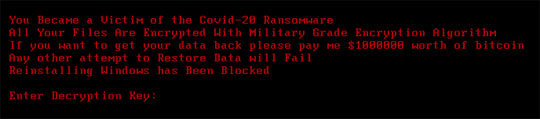
It adds the following scheduled tasks:
- Task Name: winnit
- Trigger: At startup
- Action: Start a program {Malware Path}\{Malware Filename}.exe
SOLUTION
Step 1
Trend Micro Predictive Machine Learning detects and blocks malware at the first sign of its existence, before it executes on your system. When enabled, your Trend Micro product detects this malware under the following machine learning name:
- Troj.Win32.TRX.XXPE50FFF039
Step 2
Before doing any scans, Windows 7, Windows 8, Windows 8.1, and Windows 10 users must disable System Restore to allow full scanning of their computers.
Step 3
Note that not all files, folders, and registry keys and entries are installed on your computer during this malware's/spyware's/grayware's execution. This may be due to incomplete installation or other operating system conditions. If you do not find the same files/folders/registry information, please proceed to the next step.
Step 4
Identify files detected as Boot.Win32.KILLMBR.AB, then restore the Master Boot Record and delete malware/grayware files using Recovery Console
(Note: In Windows 7, all local drives will be assigned one more than normal. For example, the C: drive becomes D:.)
• On Windows 8, 8.1, 10, and Server 2012 (R2) systems:
- Scan your computer with your Trend Micro product and then take note of the names of the malware/grayware files detected.
- Insert your Windows Installation DVD in the DVD drive, then restart your computer.
- When prompted, press any key to boot from the DVD.
- Depending on your Windows Installation DVD, you might be required to select the keyboard layout. Then on the Windows Setup window, choose your language, locale, and input method. Click Next, then click Repair your computer.
- Click Troubleshoot>Advanced Options>Command Prompt.
- In the Command Prompt window, type the following then press Enter:
BootRec.exe /fixmbr
del "{malware/grayware path and file name}" - Type exit and press Enter to close the Command Prompt window.
- Click Continue to restart the system normally.
Step 5
Deleting Scheduled Tasks
The following {Task Name} - {Task to be run} listed should be used in the steps identified below:
- winnit - Start a program {Malware Path}\{Malware Filename}.exe
For Windows 2000, Windows XP, and Windows Server 2003:
- Open the Windows Scheduled Tasks. Click Start>Programs>Accessories>
System Tools>Scheduled Tasks. - Locate each {Task Name} values listed above in the Name column.
- Right-click on the said file(s) with the aforementioned value.
- Click on Properties. In the Run field, check for the listed {Task to be run}.
- If the strings match the list above, delete the task.
For Windows Vista, Windows 7, Windows Server 2008, Windows 8, Windows 8.1, and Windows Server 2012:
- Open the Windows Task Scheduler. To do this:
• On Windows Vista, Windows 7, and Windows Server 2008, click Start, type taskschd.msc in the Search input field, then press Enter.
• On Windows 8, Windows 8.1, and Windows Server 2012, right-click on the lower left corner of the screen, click Run, type taskschd.msc, then press Enter. - In the left panel, click Task Scheduler Library.
- In the upper-middle panel, locate each {Task Name} values listed above in the Name column.
- In the lower-middle panel, click the Actions tab. In the Details column, check for the {Task to be run} string.
- If the said string is found, delete the task.
Step 6
Scan your computer with your Trend Micro product to delete files detected as Boot.Win32.KILLMBR.AB. If the detected files have already been cleaned, deleted, or quarantined by your Trend Micro product, no further step is required. You may opt to simply delete the quarantined files. Please check the following Trend Micro Support pages for more information:
Did this description help? Tell us how we did.