Künstliche Intelligenz (KI)
Securing Autonomous AI Agents with TrendAI & NVIDIA OpenShell
Learn how TrendAI and NVIDIA OpenShell help secure autonomous AI agents and build trusted enterprise AI systems with stronger visibility and control.


Save to Folio
Agentic AI is rapidly redefining how software systems operate. Instead of responding to single prompts, AI agents can now plan tasks, invoke tools, modify their own execution paths, and operate continuously over time. While this shift unlocks powerful new use cases, it also introduces an entirely new security and governance challenge for enterprises. Agentic AI is moving from experiments to production systems, forcing enterprises to confront autonomy at scale for the first time. For CISO and AI platform leaders, this creates a new governance problem.
NVIDIA OpenShell is an open source runtime to build and deploy autonomous, self-evolving agents more safely with planning, memory, and tool execution. TrendAI is working with NVIDIA to bring governance, risk visibility, and runtime enforcement directly into the agent lifecycle through integration with OpenShell.
Together, we’re addressing one of the most pressing questions facing enterprise AI leaders today: How do you safely deploy autonomous AI agents at scale without sacrificing control, compliance, or trust?
Why Agentic AI Changes the Security Model
Traditional AI security models were built around stateless interactions: prompts go in, responses come out. Agentic AI breaks that assumption.
This new wave of self-evolving agents can:
- Persist over longer periods of time with autonomous memory and identity
- Maintain local and shared memory
- Dynamically select and invoke tools or skills
- Execute code to enable new capabilities
- Route inference across a variety of local and external models
This autonomy fundamentally changes the attack surface. Risk no longer exists only at inference time—it extends across skills, tools, memory, execution environments, and agent decision logic. Static controls alone are insufficient.
Enterprises need visibility into what agents can do, what they actually do, and how those behaviors align with policy—in real time.
OpenShell: A Foundation for Agentic AI
The NVIDIA OpenShell runtime, introduces foundational elements such as:
- Sandboxed execution environments
- Local memory and file system isolation
- Tool and skill invocation boundaries
- Model routing between local and external inference with data privacy
Rather than prescribing a single security solution, OpenShell is open source and designed to enable ecosystem partners to extend and strengthen its security posture for enterprise use cases.
That is where TrendAI enters the picture.
Embedding Security Across the Agent Lifecycle
TrendAI brings decades of foundational knowledge in behavioral analysis, sandboxing, threat intelligence, and policy enforcement to agentic AI. For OpenShell, this expertise is applied through a layered architecture that secures agents before execution, during runtime, and after an action occurs.
1. Governance often breaks down once agents begin acting autonomously
Enterprise administrators define AI governance and compliance policies centrally using TrendAI Vision One™. These policies are distributed directly into the OpenShell runtime, ensuring that agent behavior aligns with organizational requirements for security, compliance, and data handling. This shifts governance from a theoretical policy document into an enforceable runtime control.
2. Skill and Tool Risk Visibility with Agentic Scan
Agent capabilities are only as safe as the skills and tools they can access. Agentic Scan continuously inventories and analyzes:
- Agent skills
- Model Context Protocol (MCP) integrations
- Tool definitions available within the agent environment
Declared skill behavior is compared against observed behavior, helping identify deceptive, unsafe, or non‑compliant functionality before it becomes operational risk.
For example, an agent may attempt to invoke an unapproved MCP service or access a tool outside its declared scope, creating hidden exposure that static reviews would miss.
3. Dynamic Behavioral Analysis
Some threats do not reveal themselves until code executes.
TrendAI applies dynamic analysis by executing skills and tools in isolated environments to observe real runtime behavior for:
- Hidden malicious actions
- Unauthorized system access
- Anomalous network or file activity
The result is high‑fidelity risk intelligence that goes beyond static inspection.
4. Policy Enforcement at Runtime Security controls are enforced inline—at the moment agents attempt to act.
Based on governance policies, reputation intelligence, and behavioral analysis, OpenShell agents can be prevented from:
- Executing untrusted skills
- Invoking restricted tools
- Performing non‑compliant actions
This enforcement happens without disrupting approved workflows, preserving innovation while maintaining control.
5. AI‑Specific Threat Protection
Agentic systems introduce new classes of AI‑native attacks, including:
- Prompt injection
- Indirect prompt manipulation
- Sensitive data leakage
TrendAI Vision One AI Application Security™ plugin inspects prompts, responses, and model interactions, enforcing policy across both local and external inference paths.
6. Continuous Monitoring and Auditability
Long‑lived agents demand continuous oversight.
Telemetry from agent execution, tool usage, and sandbox environments flows into TrendAI’s agentic SIEM, enabling:
- Real‑time anomaly detection
- Post‑execution forensics
- Compliance and audit reporting
This provides enterprises with the visibility required to operate autonomous systems responsibly.
7. Static trust models fail as agent ecosystems and threats constantly change.
TrendAI’s global threat intelligence continuously scores:
- Skills
- MCP services
- Related indicators of compromise
This intelligence feeds directly into governance and enforcement decisions, allowing security posture to adapt as threats evolve.
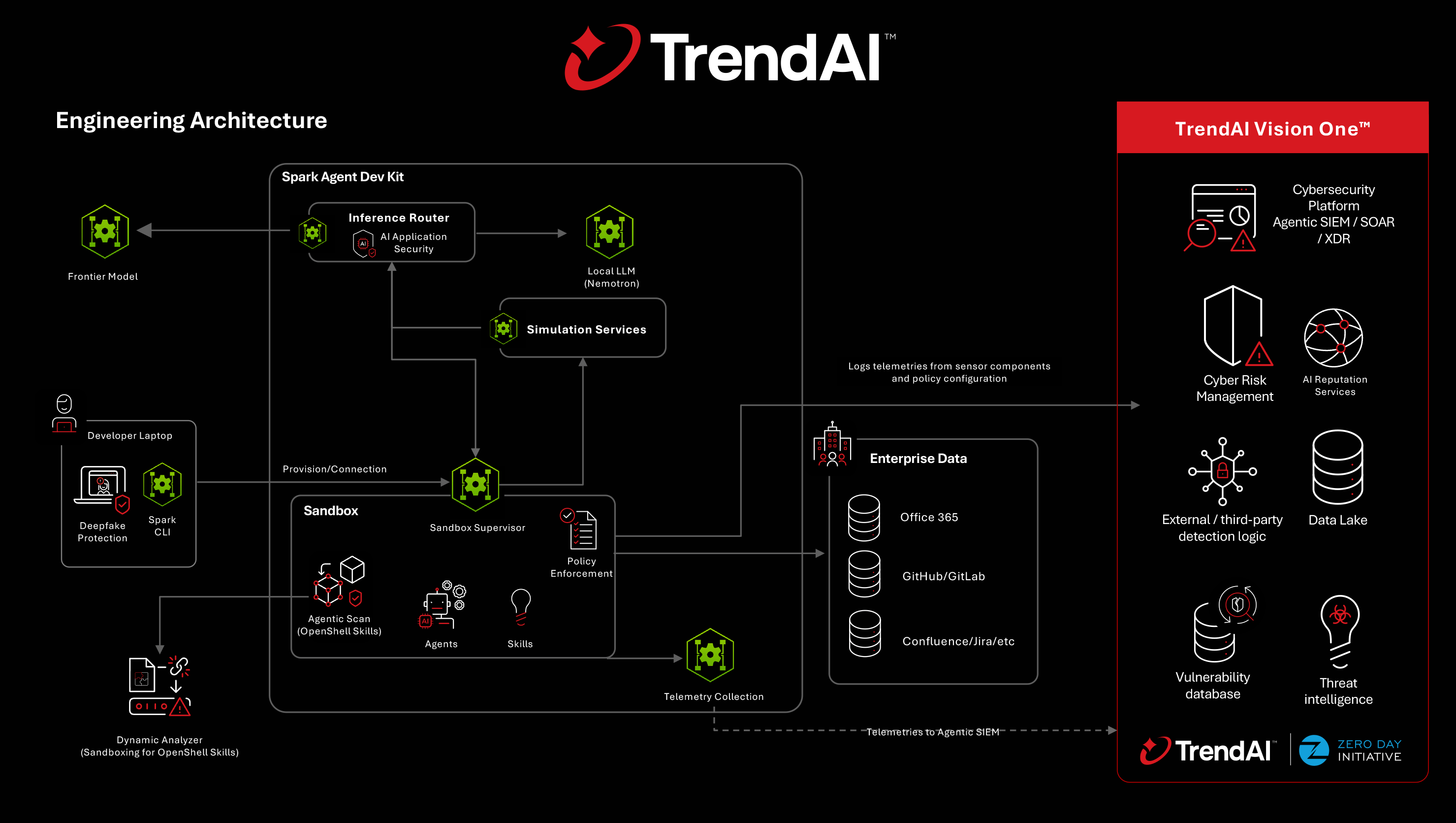
Aligned with NVIDIA Agent Toolkit
OpenShell does not exist in isolation. It is part of NVIDIA’s broader agentic ecosystem, and NVIDIA Agent Toolkit software including NVIDIA AI‑Q and the NVIDIA NeMo Agent Toolkit, which support agent orchestration, observability, and reuse at scale.
TrendAI’s security integrations extend across these frameworks, enabling consistent governance and risk management as agentic applications move from developer environments into enterprise and AI factory deployments.
From Experimentation to Production
The collaboration between NVIDIA and TrendAI defines how enterprises should deploy agentic AI at scale, moving from experimental autonomy to enterprise‑grade systems
By combining:
- NVIDIA software, including the OpenShell runtime for autonomous, self-evolving agents
- TrendAI’s governance, behavioral analysis, and enforcement capabilities
Enterprises gain a practical, scalable path to deploying autonomous AI agents without surrendering control, trust, or accountability.
Agentic AI does not have to be a choice between innovation and security. With OpenShell and TrendAI, it becomes a governed, observable, and enforceable platform—ready for the enterprise.