
 Download the PDF
By Ted Lee (Senior Engineer-Threat Research, APT Ops), Kakara Hiroyuki (Senior Threat Researcher, Forward-Looking Threat Research Team AI and Data), and Feike Hacquebord (Principal Threat Researcher, Forward-Looking Threat Research Team)
Advanced persistent threats (APTs) are becoming smarter and more efficient, with the groups involved in this area operating with high precision, coordinating their efforts to stay hidden within their targets’ systems for as long as possible. Our 2025 report compiles a full year of research and real-world observations to show security leaders exactly how these actors operate and how to fight back. Our aim is to provide a clear view of the motives and tactics used in current cyberattacks.
Modern APTs have evolved into persistent, semi‑autonomous entities pursuing geopolitical and economic objectives. Over the past year, the threat landscape shifted as attackers moved from experimenting with AI as a support tool to integrating it across the intrusion lifecycle. Campaigns have become increasingly stealthy and long‑lived, blending into normal network activity while AI‑assisted components accelerate lateral movement, targeting decisions, and privilege escalation. At the same time, many APT actors are increasingly favoring the abuse of legitimate tools, cloud services, and trusted platforms, an approach that pairs naturally with AI‑driven evasion. The result is a sharp increase in attacks against critical industries and regional hubs, and a narrowing window between initial access and real‑world impact.
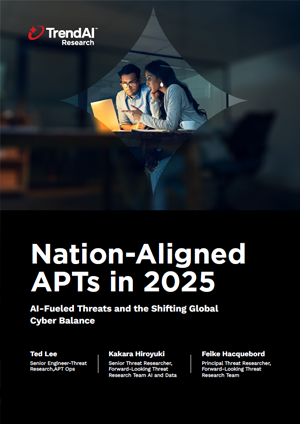
Our report, titled Nation‑Aligned APTs in 2025: AI‑Fueled Threats and the Shifting Global Cyber Balance, focuses on what has changed in APT actor tools, tactics, and capabilities, and how organizations must adapt as AI becomes a core feature of the modern APT threat.
Strategic AI Postures of Major Nation‑Aligned Threat Ecosystems
China
“Full‑Stack Anchor”
China has built a self‑sustaining AI ecosystem, combining efficient models and massive energy infrastructure, enabling it to compete at scale in AI development despite sanctions.
North Korea
“Asymmetric Saboteur”
North Korea is leveraging AI to automate cybercrime, using advanced compute access and social engineering to fund state priorities like its missile program.
Russia
“Sovereign Fortress”
Russia is applying AI to warfare and surveillance, offsetting hardware constraints with energy resources and increasing reliance on Chinese technology and allied support.
What’s Inside
Our report delivers a strategic, intelligence‑driven view of how APT operations evolved in 2025 and what defenders should expect next. The report merges real-world incidents with forward-looking analysis, linking geopolitical shifts and emerging AI capabilities to observed attack patterns.
Inside, readers will find:
- Key takeaways for security leaders, summarizing how AI, collaboration among APT groups, and geopolitical alignment are reshaping the threat landscape
- A strategic overview of the 2025 APT environment, highlighting the rise of AI‑integrated kill chains and the shift toward machine‑speed operations
- Geopolitical threat analysis covering China, Russia, and North Korea, including how national priorities and AI investments influence cyber activities
- Detailed profiles of major APT campaigns, tools, and tactics observed in 2025, mapped to aligned threat actors and real incidents
- A forward‑looking strategic outlook (2026–2027) examining autonomous attacks, AI agents, and evolving collaboration models
- Practical risk‑mitigation guidance for organizations operating under an assumed‑breach approach, focused on resilience, visibility, and collective defense
Together, these sections provide decision‑makers and defenders with the strategic guidance needed to navigate an era of AI‑enabled, geopolitically driven cyberthreats.
The 2025 report comes from year-round monitoring and incident analysis. Rather than looking at isolated events, the research correlates information across multiple industries and environments to find the meaningful trends that affect a security posture.
How AI and Strategic Shifts Are Redefining Modern APT Campaigns
“APT actors are increasingly using AI platforms to automate attack workflows and enhance evasion capabilities. In the near future, attackers will use AI-driven reconnaissance to map corporate and government network infrastructures and quickly identify vulnerabilities.”
The 2025 threat landscape shows that AI is no longer an experimental capability for APT groups, but an operational component embedded directly into campaigns. Nation‑aligned APT actors are increasingly using AI‑assisted tools for reconnaissance, phishing lure generation, and early forms of automation across the attack lifecycle. While fully autonomous attacks are still emerging, even partial automation has significantly increased attack speed and reduced the time defenders have to detect and contain intrusions.
Another defining shift is the rise of collaboration and specialization among APT groups. Rather than operating as isolated units, multiple actors now share access, infrastructure, and intelligence. Models such as “Premier Pass‑as‑a‑Service” allow one group to establish and maintain access while others conduct exploitation, making attacks faster to execute and harder to attribute. This trend, combined with the increased use of legitimate tools and cloud services, has extended dwell times and complicated incident analysis and response efforts.
Finally, target selection is driven by strategic rather than opportunistic priorities. Government institutions, technology firms, manufacturing, and energy organizations remain the most frequently targeted sectors due to their role in national security, supply chains, and geopolitical leverage. At the same time, edge devices and software supply chains have become preferred entry points, offering stealthy access beyond traditional security controls. Together, these changes underscore a shrinking defender response window and reinforce the need for continuous visibility, rapid containment, and resilience at machine speed.
Who Is This For?
Anyone responsible for keeping an organization safe will find value here. CISOs and Security Directors will gain a strategic view of how AI adoption, APT collaboration models, and geopolitical alignment are reshaping long‑term cyber risk. The report helps leaders prioritize investment, assess exposure across business‑critical sectors, and frame clear, defensible narratives for executive discussions.
Meanwhile, SOC Teams and Threat Intelligence Analysts will find detailed insight into how modern APT actors operate in practice, how access is established, shared, and expanded, how AI accelerates attacker decision‑making, and where detection and response windows are shrinking. Engineers can use the report’s analysis to refine detection logic, validate assumptions around assumed‑breach workflows, and align controls to emerging attacker behaviors.
Finally, Risk, Policy, and Governance Teams gain the geopolitical and strategic context needed to understand why certain industries and regions are targeted, supporting informed risk assessments, regulatory alignment, and cross‑functional planning.
Whether deciding where to allocate budgets, informing defensive roadmap decisions, or briefing leadership on the evolving threat environment, this report equips organizations with the clarity needed to make confident, informed calls.
Read the Full Report
The 2025 annual APT Report goes much deeper into these findings with detailed data and expert commentary. Download the full version to see the complete picture of the threat landscape and what it means for your team in the year ahead.
Like it? Add this infographic to your site:
1. Click on the box below. 2. Press Ctrl+A to select all. 3. Press Ctrl+C to copy. 4. Paste the code into your page (Ctrl+V).
Image will appear the same size as you see above.
 Fault Lines in the AI Ecosystem: TrendAI™ State of AI Security Report
 It’s By Design: The Use-After-Free of Azure Cloud
 TrendAI™ 2026 Cyber Risk Report
 Guarding LLMs With a Layered Prompt Injection Representation