Minacce cyber
What’s your CNAPP maturity?
More and more enterprises are opting for cloud-native application protection platforms (CNAPPs) instead of complex and hard-to-manage cloud security point solutions. Find out where your organization is on its CNAPP maturity journey.


Save to Folio
Migrating to a cloud-native application protection platform (CNAPP) isn’t something most enterprises can do overnight. But more are taking the steps to adopt CNAPPs as a way of strengthening their cloud security. This blog looks at some of the reasons why that transition is happening and offers a simple roadmap to help organizations determine where they sit on the CNAPP maturity scale.
After years of duct-taping together cloud security with point solutions, a lot of teams are officially over the fragmented dashboards, nonstop alerts, and that creeping feeling that something risky is lurking just out of view.
According to Gartner, “Many Fortune 500 companies are moving away from siloed, multi-tool security stacks and toward cloud-native application protection platforms (CNAPPs).” And in June 2025, KuppingerCole noted that increased enterprise use of generative AI (genAI) and machine learning (ML) will further drive CNAPP adoption, with AI security posture management an increasingly key component.
CNAPPs integrate cloud monitoring, reporting, and threat detection in one platform, making risks more visible and enabling faster security responses to threats and breaches. While that unification is a marked advantage, migrating to a CNAPP isn’t exactly a ‘flip of a switch’ proposition. It takes some time and planning based on your organization’s specific starting point. This blog looks at the four main stages of CNAPP maturity to help pinpoint where you might be at, and what your most logical next steps should be.
Why CNAPP matters
Few organizations today rely on a single cloud provider. Most are engaged in architecting hybrid and multi-cloud environments, blending on-premises infrastructure with public and private cloud services. This shift isn’t just about technology; it’s also a strategic move to unlock agility, resilience, and innovation.
Diverse and distributed environments like those are complex and hard to secure. A big issue for security teams is lacking complete, integrated visibility across the whole environment. By unifying the view of ‘all clouds’ in one platform, CNAPP makes it far simpler for security teams to assess, prioritize, and mitigate cloud risks, leveraging automation for scale and speed.
Beyond comprehensive visibility, a full-featured CNAPP can provide end-to-end protection for cloud assets and not only automate but also orchestrate security processes. Having an integrated platform tends to streamline functions such as security policy and compliance management and makes cloud security scalable. Ideally, a CNAPP will also integrate with existing infrastructure to avoid redundancies and help control costs.
Having confidence in the security of a complex, multi-cloud environment frees organizations to take full advantage of cloud agility and scalability, innovate with minimal friction, and capitalize on AI advancements.
Today, however, few organizations are at that final stage of complete CNAPP maturity. Most are at other points along the journey.
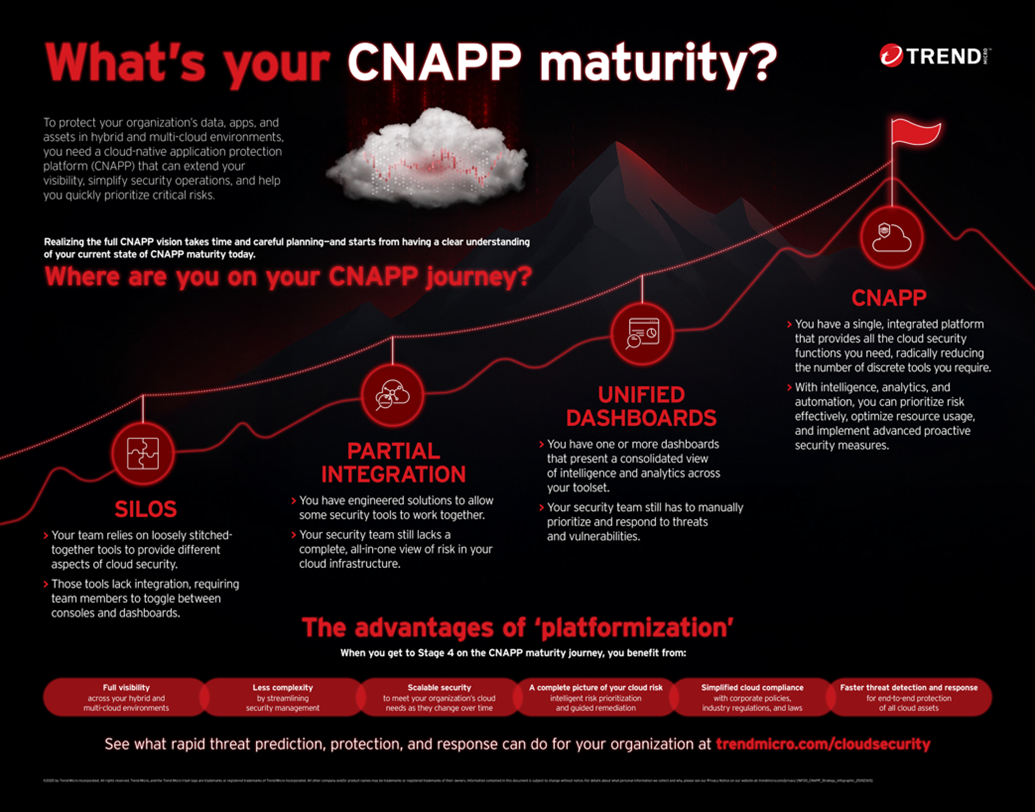
Rate your CNAPP maturity
STAGE 1: SILOS
Despite the momentum that’s built around CNAPPs in the last few years, many organizations are still at this stage of the process, dealing with multiple point tools to meet different cloud security needs. It’s understandable insofar as companies have spent a lot on these tools over the years and, however unwieldy they may be, their teams know how to use them.
But the lack of a holistic understanding of the total risk situation and how it’s evolving is bound to become unsustainable, especially as cloud complexity continues to intensify. Eventually, without integration, security teams are going to be overwhelmed, or the organization’s security posture is going to degrade unacceptably.
STAGE 2: PARTIAL INTEGRATION
Breaking out of tool silos usually begins with a (usually custom) effort to engineer some integration between existing security solutions. This can be time-intensive and/or costly depending on available internal resources or the need to bring in outside help. Any measure of integration is undeniably helpful, but at this stage the team is still going to have visibility gaps across the cloud environment, meaning the picture of risk is incomplete.
STAGE 3: UNIFIED DASHBOARDS
The next step beyond partial integration is to consolidate what those ‘cooperating’ tools are finding in a single view. This can significantly speed up analysis and allow for manual prioritization of vulnerabilities and threats but still leaves the security team with a heavy workload and slower responsiveness than they would have with automation.
STAGE 4: CNAPP
CNAPP consolidates and builds on the gains of integration and unified visibility and takes them to another level. Because it is purpose-built as a platform, it provides a truly comprehensive and fully integrated view of the cloud environment, with all the tools or security functions needed built in. This virtually eliminates tool sprawl and puts additional intelligence and automation to work for your security team so they can prioritize faster and more precisely and get ahead of threats by implementing proactive security measures.
Just as importantly, a CNAPP helps break down organizational silos by giving security, DevOps, and cloud teams a shared view of risk, enabling better collaboration, faster decision-making, and more aligned responses.
Trend as a CNAPP leader
Trend Micro has been a proponent of the platform approach to cybersecurity for years. Gartner, IDC, and Forrester have all recognized our Trend Vision One™ Cloud Security solution as a leading example of CNAPP for proactive cloud security. We use AI-powered threat prediction and real-time responsiveness to realize the full potential of CNAPP to help security teams stay ahead of evolving risks.
The value of the CNAPP market exceeded US$3.4 billion in 2024 and is only expected to keep growing. As it does, and as cloud security needs continue to evolve, our commitment is to help organizations progress along the CNAPP maturity journey and reach a place where they can have real confidence in their cloud security.
Explore what comprehensive, proactive cloud security can do for your organization with Trend Vision One™ Cloud Security.