Phishing
Enhancing Security Awareness with Cyber Risk Exposure Management
Learn how to strategically tackle human risk for smarter prioritization and lasting behavioral change.


Save to Folio
Every employee now works in security, whether they signed up for it or not. Attackers are leaning into people as the path of least resistance and AI is smoothing that road even further. Gone are the days of clumsy typos and evidently suspicious links. Today’s attacks are powered by AI-generated content and hyper-personalized social engineering. These campaigns can replicate internal workflows, mimic colleagues, and simulate legitimate requests with ease.
Humans are still the weakest link, but it’s not their fault
Employees are making dozens of security decisions a day, often without thinking twice. GenAI has reduced the time needed to craft a convincing phishing email from 16 hours down to only 5 minutes. Attackers can now quickly generate scripts to scrape social media posts and create personalized emails for their target. Environments have also grown more complex and a single click entering an environment can cascade outward.
Meanwhile, employees are expected to keep pace with new tools, adapt to policy updates, and recognize evolving attacks, all while managing their day job. The constant motion can often result in risk fatigue.
Siloed security awareness training isn’t cutting it
Whether it is a technical vulnerability or human behaviour, cybercriminals see one ecosystem of weakness. However, many organizations still manage their risk in silos. They oversee their organization’s technical risk in one tool and run phishing simulations in another. Today, that separation can be a liability.
Additionally, generic annual phishing campaigns and training modules are not enough. An effective tool should be personalized and strategic, so that you can influence behaviour in the right way at the right time. Phishing simulations should also evolve alongside the threat landscape. By tailoring simulations to mimic current attack techniques, you can ensure employees are prepared for the threats they are most likely to encounter.
The case for adding human risk to your exposure management strategy
Cyber risk and exposure management starts with visibility, and your view is incomplete without humans in it. Accounting for human risk gives you more insight into where your organization is vulnerable and allows you to tackle threats with more context.
Phishing simulation results are just one piece of the puzzle. This strategy provides all the activity and intelligence to build a comprehensive risk profile for your employees. Instead of doing blanket training, you can then prioritize specific types of training where it will bring the most value.
When awareness training is integrated into broader exposure management strategies, it can help security teams:
- Measure human risk by analyzing an employee’s identity data, security habits, and awareness levels.
- Automatically target high-risk users with training, so you are offering personalized guidance at the right time
- Predict which employees are most likely to be part of potential attack paths and educate them
- Take advantage of a continuous feedback loop because phishing simulation results and training completion statistics will feed into real-time risk scoring models
- Save time by setting up automated workflows to deliver training to specific employees based on the conditions and criteria you select
The ultimate goal of a security awareness training program is to create lasting behaviour change. This new strategy would allow you to track holistic metrics like your organization’s overall risk of account compromise and the number of accounts with weak authentication.
An example of strategically targeting human risk
Consider a global enterprise who is aiming to educate their employees and reduce their risk of account compromise. Instead of relying on quarterly annual simulations and generic training modules, they leverage a solution that integrates security awareness training with technical risk data.
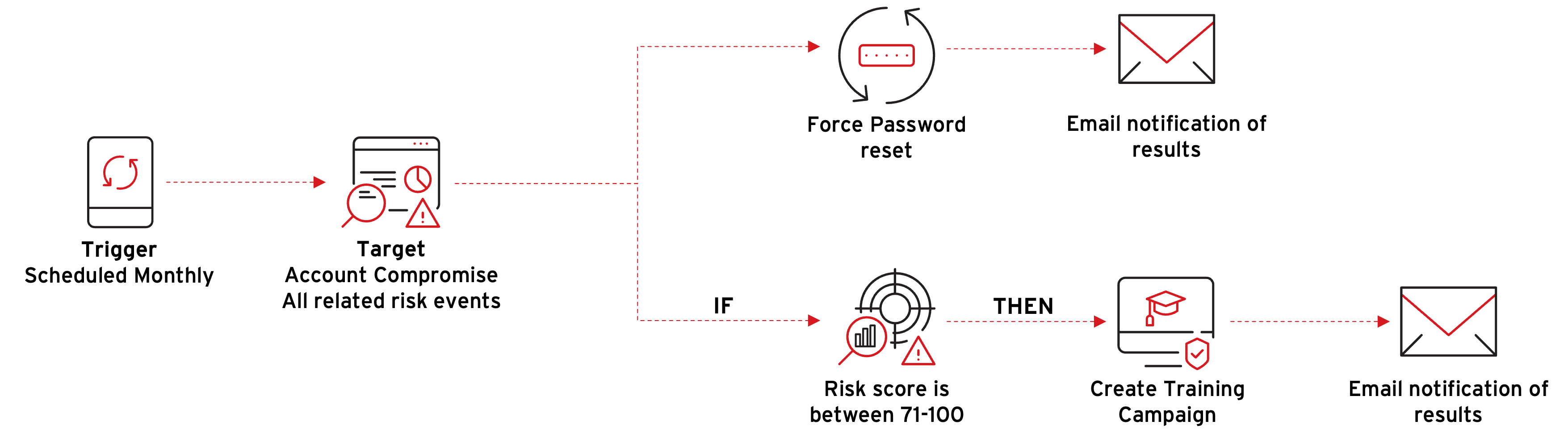
First, they set up automated workflows to save time and effort. So, when the tool identifies indicators of account compromise, it automatically forces a password reset for the affected account and sends email notifications to the security team with the details. To reinforce secure behavior and prevent recurrence, it delivers relevant awareness training to the impacted user on password protection and MFA.
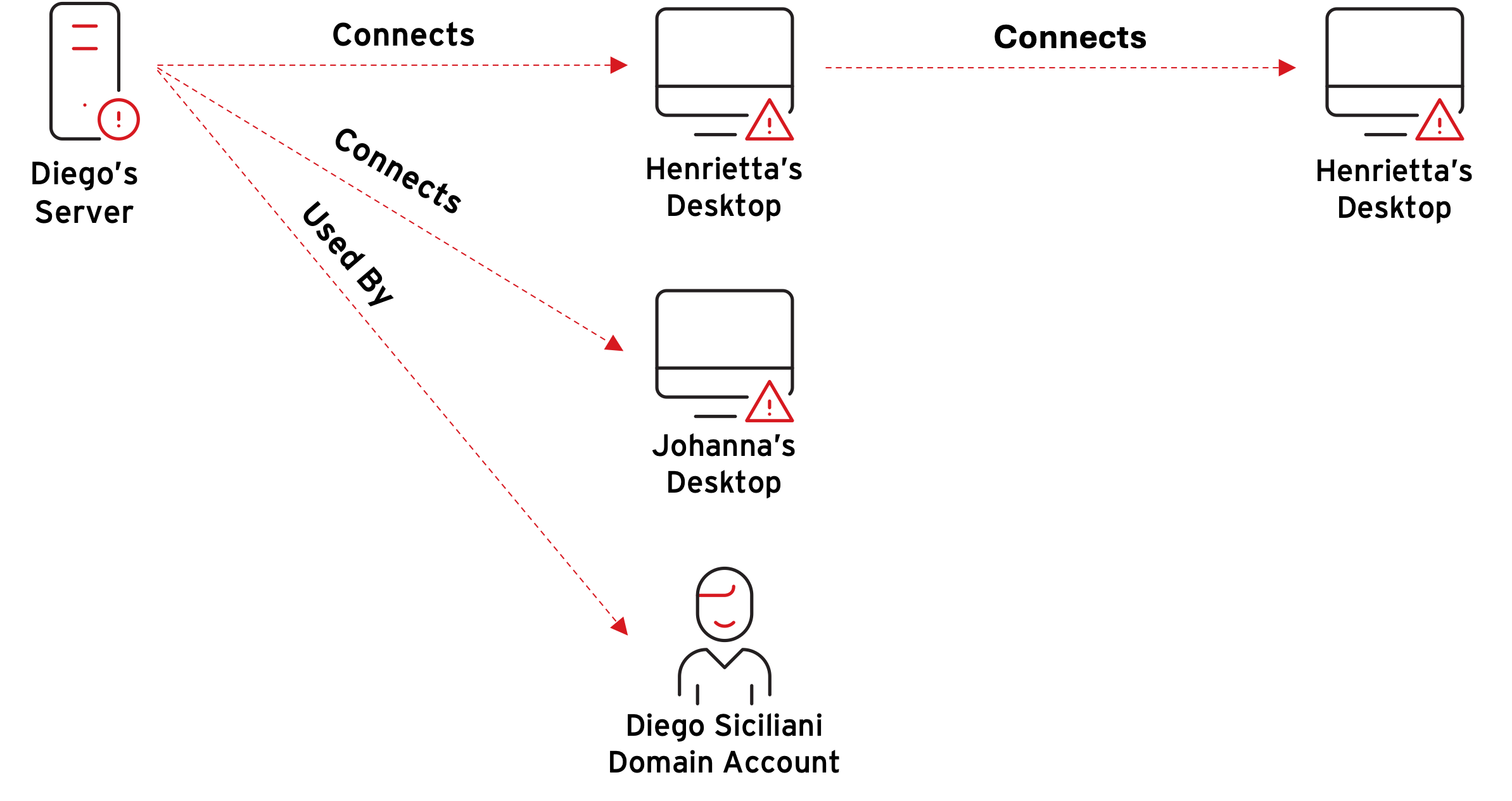
Second, they use attack path prediction to see which users sit on critical lateral movement routes. They see that an attack could compromise an internet exposed device and pivot laterally through endpoints, eventually reaching a domain account with high privileges. They proactively deliver awareness training to the connected users.
As employees complete awareness training, their individual risk scores will update in real time. The security team can now monitor these improvements and adjust their strategy to focus on the accounts most likely to be targeted again. This is where security awareness training becomes strategic rather than a compliance checkbox.
Next steps
The human element is just one facet of your organization's risk. Through Trend Vision™ One Cyber Risk Exposure Management, you can address your entire attack surface including unknown, unmanaged, and 3rd party assets. We combine key capabilities like security awareness, vulnerability management, identity security, and more into one powerful solution so you can prioritize remediation and strategically reduce your risk.
True resilience means treating people as part of your exposure map. The Trend Vision™ One Security Awareness app is part of our Cyber Risk Exposure Management offering. Learn how we can support you on your journey.